When Should a Hardware Startup Use Turnkey PCB Assembly?
Direct answer: A hardware startup should consider turnkey PCB assembly when its design is sufficiently defined but the team lacks time or infrastructure to coordinate PCB fabrication, component purchasing, assembly, and logistics separately. Turnkey is a poor substitute for unresolved engineering ownership. Strategic components, rapidly changing parts, or company-controlled inventory may be better handled through consigned or partial-turnkey arrangements.
What decision does this guide support?
The decision is about allocation of coordination work and purchasing control, not simply convenience. A single commercial interface can reduce handoffs, but the startup still must approve substitutions, release files, define test acceptance, and fund material exposure. Evaluate the sourcing model for the next build stage rather than treating it as a permanent supplier policy.
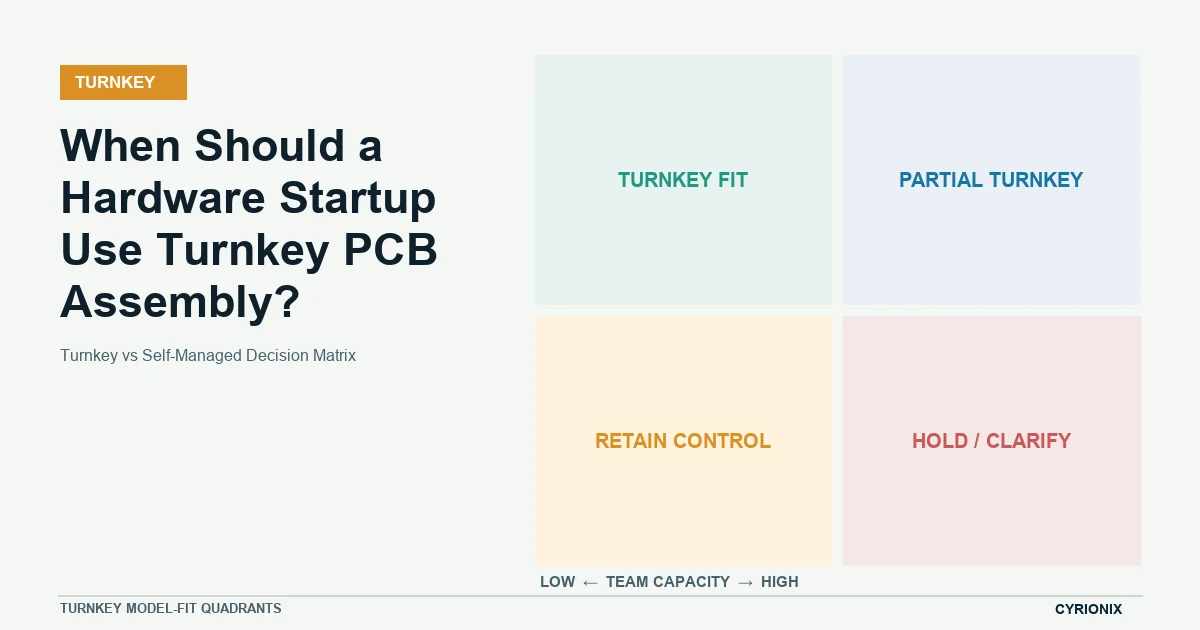
Turnkey versus self-managed decision matrix
Use the matrix to compare full turnkey, partial turnkey, and self-managed sourcing against actual team constraints. A stop condition means the operating model would conceal rather than solve the underlying risk.
| Decision factor | How to evaluate it | Stop condition |
|---|---|---|
| Internal bandwidth | Use turnkey when the team cannot coordinate multiple fabrication and sourcing lanes. | Engineering approvals would still become a bottleneck. |
| BOM stability | Use full scope when parts and alternate rules are sufficiently defined. | Core components are still being selected. |
| Sourcing control | Retain or consign strategic parts when commercial or traceability control matters. | The ownership model conflicts with company policy. |
| Change frequency | Consider partial turnkey while the design is changing rapidly. | Purchased exposure would outrun revision confidence. |
| Test maturity | Define test responsibility regardless of who buys material. | Turnkey is expected to invent product acceptance. |
| Decision load | Choose the model that makes approvals visible and manageable. | A single-contact model hides unresolved authority. |
When full turnkey is a strong fit
Full turnkey is useful when the package is released, the approved sourcing rules are clear, and internal staff would otherwise spend disproportionate time placing many small orders and coordinating arrivals. It can also simplify accountability for shortages and kit completeness. The quote must still disclose major material assumptions, excess inventory, and approval gates.
When retaining sourcing control is valuable
Startups may prefer to buy and consign scarce processors, radios, sensors, programmed devices, or parts covered by investor, customer, or quality controls. Existing inventory and negotiated distributor agreements can also favor customer ownership. Consigned material requires accurate quantities, labeling, traceability, and an agreed reconciliation process.
Use partial turnkey as an intentional middle ground
A partial model can place common passives and standard fabrication under the assembler while the startup supplies strategic or volatile components. This reduces purchasing workload without surrendering control of the most consequential lines. Define who covers attrition, shortages, incoming discrepancies, and unused balances for each ownership category.
Match the model to design maturity
Frequent changes increase the chance that purchased material becomes obsolete. During early prototypes, buy conservatively and keep approval cycles short. As the release stabilizes and repeat demand becomes more credible, broader turnkey purchasing and planned inventory can become economical.
Do not outsource product acceptance
The manufacturer can execute documented programming, inspection, and test work, but the startup owns the definition of correct product behavior. Supply binaries, fixtures or fixture requirements, limits, golden references, and failure disposition. A turnkey quotation that says “functional test” without those inputs does not resolve acceptance.
Keep approvals visible in a single-contact model
One coordinator should consolidate questions, evidence, and commercial effects, then route them to a named startup decision maker. Record substitutions and deviations against the affected build. Single contact is valuable when it reduces communication overhead, not when it hides the source or consequence of a change.
Choose the sourcing model for one build
- Classify BOM lines. Separate strategic, constrained, already-owned, and readily sourced material.
- Estimate coordination load. Count purchase orders, expected exceptions, internal buyer time, and approval capacity.
- Define ownership explicitly. Assign purchasing, attrition, excess, storage, traceability, and substitution responsibility by category.
Startup turnkey questions
Is turnkey always more expensive?
Not necessarily. The quoted service and material markup must be compared with internal purchasing labor, fragmented freight, kit shortages, excess handling, and schedule impact. Normalize scope before comparing price.
Can a startup supply only one critical IC?
Yes, if the responsibilities are agreed. Confirm supplied quantity, attrition allowance, packaging and traceability, delivery date, incoming discrepancy handling, and return of unused material.
Who approves a turnkey component substitution?
The authorized customer engineering owner should approve changes that affect design intent. The sourcing or manufacturing team can identify candidates and provide evidence, but it should not silently select functional equivalents.
Related Cyrionix resources
Compare ownership models in the turnkey versus consigned PCB assembly guide. The component sourcing resource covers alternate and source controls.
Technical references
- Altium ActiveBOM verification documentation
- Altium substitute-component documentation
- Protolabs prototype-to-production white paper
Choosing a sourcing model? Review turnkey PCB assembly scope for the next released build.