Low-Volume PCB Assembly for Beta Programs and Field Trials
Direct answer: Low-volume PCB assembly is appropriate for a beta program or field trial when the hardware and firmware are stable enough to give participants a comparable product, but the team still needs real-use evidence before committing to volume production. Batch size should follow the learning objective, support capacity, failure-analysis plan, and replacement inventory, not an arbitrary “pilot” quantity.
What decision does this guide support?
This framework helps product and operations teams choose a controlled deployment size and release standard. A field trial introduces environment, user behavior, installation, transport, and support variables that bench prototypes may not reveal. It is still an engineering experiment, so every unit should be traceable to a known build and feedback should lead to a defined decision.
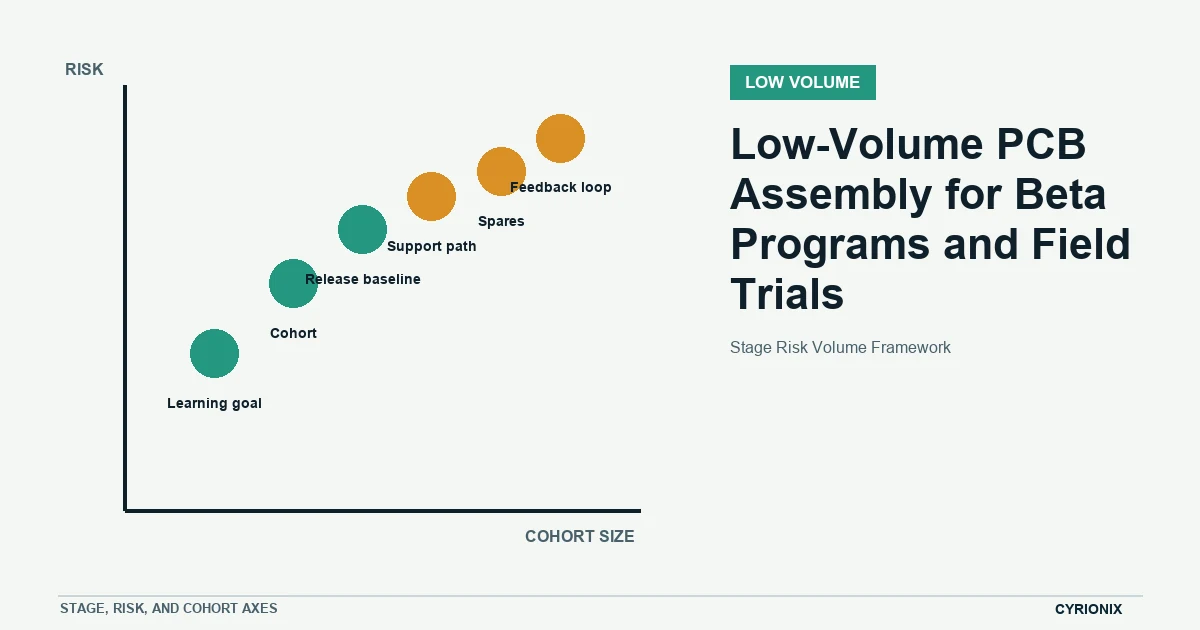
Stage, risk, and volume framework
Use the six controls to connect volume with risk and learning capacity. If the team cannot support or identify each deployed unit, increasing the quantity generally reduces the quality of evidence.
| Control point | Required action or evidence | Hold condition |
|---|---|---|
| Learning goal | State what field behavior, environment, workflow, or reliability question is being tested. | The beta has no decision it is meant to inform. |
| Cohort | Choose a bounded user group and deployment context the team can support. | More units would exceed feedback or support capacity. |
| Release baseline | Freeze hardware, firmware, accessories, and test evidence for the cohort. | Participants could receive materially different configurations unknowingly. |
| Support path | Define issue intake, severity, return, replacement, and escalation ownership. | A field failure cannot reach engineering quickly. |
| Spares | Allocate diagnostic, replacement, destructive-analysis, and reference units deliberately. | A replacement would consume the last engineering reference. |
| Feedback loop | Tie observations to serial, revision, environment, and disposition. | Feedback cannot be connected to a known unit state. |
Define the decision the field trial must inform
State the unresolved question before selecting quantity: installation time, wireless performance, thermal behavior, power quality, user workflow, enclosure durability, serviceability, or another measurable issue. Define what result would trigger release, another iteration, or a stop. A broad objective such as “get feedback” is not sufficient to design the build or test plan.
Choose a bounded and representative cohort
Select users, sites, climates, duty cycles, and installation conditions that represent the intended uncertainty without exceeding the team’s support capacity. More units improve coverage only when data remains attributable and incidents can be investigated. Document participant selection and known exclusions so results are not generalized beyond the trial.
Freeze the deployed configuration
Release the PCB, assembly variant, firmware, enclosure, cable set, calibration, and factory test together. If a change is necessary during the program, record which serial numbers received it and why. Mixing materially different configurations without traceability makes field results difficult to interpret and can hide a regression.
Prepare support and failure capture before shipment
Define issue intake, severity, remote diagnostic data, return authorization, replacement criteria, and escalation to engineering. Provide the support team with revision and serial lookup. Field failures should preserve symptoms, environment, logs, photos, and chain of custody where failure analysis matters.
Allocate spares by purpose
Separate replacement units from engineering references, destructive-analysis samples, installation spares, and retained golden units. The right allowance depends on failure consequence, geography, repair turnaround, and trial duration. Do not consume the only known-good reference to satisfy a routine replacement request.
Close the feedback loop into the next build
Review observations by severity and reproducibility, then link each action to a design change, firmware change, process correction, documentation update, or accepted limitation. Preserve unit-level build and test records. The trial is complete when the planned decision has evidence, not merely when the deployment period ends.
From beta objective to build quantity
- Set coverage. List environments and user behaviors required to test the main assumptions.
- Set operational capacity. Estimate how many installations, incidents, returns, and replacements the team can handle well.
- Set the production reserve. Add purpose-specific spares and engineering samples, then release one traceable configuration.
Field-trial production questions
How many units make a low-volume beta build?
There is no universal threshold. Use the smallest cohort that covers the target conditions and supports the planned analysis, then add explicitly allocated spares. The number should be justified by the program, not by a supplier label.
Can firmware change during the trial?
Yes, when the change is controlled. Record firmware identity per unit, the reason and date of deployment, and whether results before and after the change remain comparable.
Should beta units use production test coverage?
They should use coverage adequate to separate manufacturing defects from field behavior. The final production test may still evolve, but undocumented or inconsistent acceptance makes beta data much less reliable.
Related Cyrionix resources
The prototype versus low-volume guide helps define the transition point. Use the cost-driver guide when planning the commercial scope of a pilot batch.
Technical references
- Protolabs prototype-to-production white paper
- IPC assembly acceptance and soldering standards
- Altium design-variant documentation
Preparing a beta batch? Review low-volume PCB assembly coordination for a traceable field-trial build.