
PCB Assembly Cost: What Actually Drives the Price?
Compare quotations by scope and assumptions across fabrication, components, setup, quantity, assembly complexity, verification and logistics.
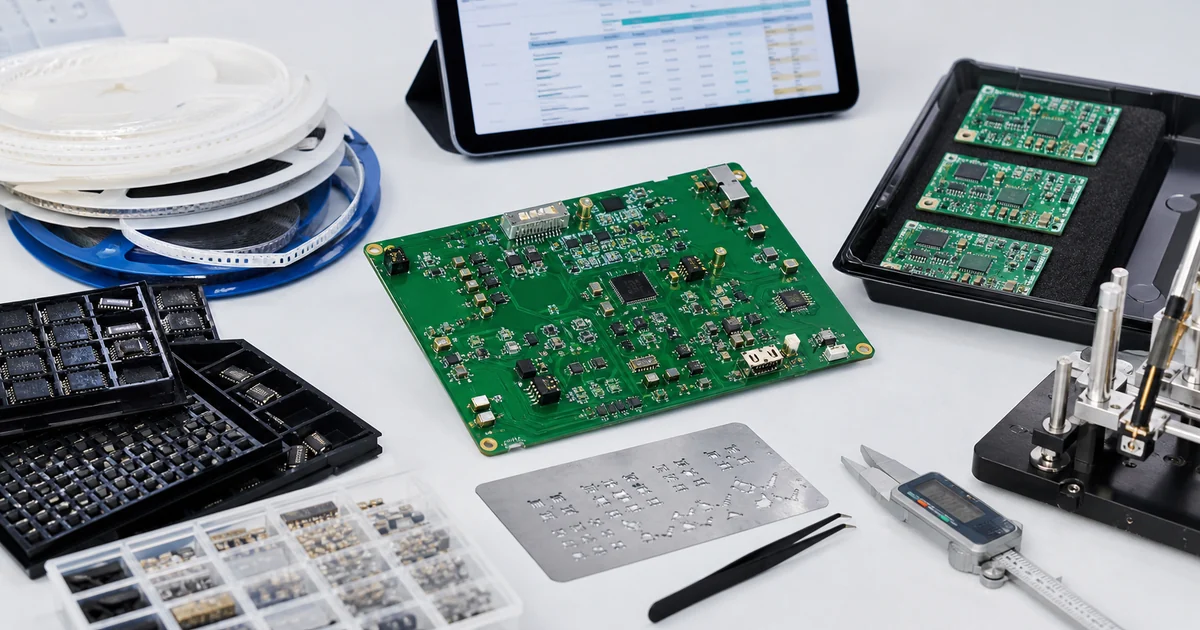
PCB assembly cost combines PCB fabrication, components, purchasing, setup, placement and soldering effort, inspection, programming, testing, handling and logistics. Quantity changes how fixed setup is distributed, but two quotes are comparable only when they use the same revision, sourcing responsibility and verification scope.
PCB Assembly Cost Driver Framework
| Cost factor | Why it matters | What the buyer can prepare |
|---|---|---|
| PCB fabrication | Layer count, material, finish, geometry and panel use affect fabrication | Complete Gerber/drill data, stack-up needs and fabrication notes |
| Components | Part price, MOQ, packaging, availability and excess ownership vary | Exact MPNs, approved alternatives and consigned-part list |
| Setup | Stencil, programming, tooling and line preparation are spread across quantity | Current quantity, credible follow-on demand and stable revision |
| Assembly complexity | Package mix, board sides and manual operations change process effort | Accurate CPL, assembly drawing and special handling notes |
| Inspection and test | AOI, X-ray, programming and functional testing cover different questions | Required methods, coverage, fixtures and pass criteria |
| Schedule | Expedited material or production decisions may narrow options | Target completion date, approval owner and delivery destination |
| Logistics | Packaging, shipping, duties and terms depend on destination | Delivery address, packaging need and commercial terms |
Why does quantity matter?
Some setup work occurs once per revision or batch, so a larger quantity can distribute it across more boards. That does not make a larger order automatically cheaper in practice: units built before the design is stable can become obsolete or require rework.
How do components and testing affect cost?
Components can dominate total cost when part price, MOQ, packaging and shortage exposure are included. Verification cost depends on what must be inspected or measured, whether test access exists, and who supplies firmware or fixtures. A clear scope prevents a low quote from hiding missing coverage.
What improves quote accuracy?
- Send matching Gerber, drill, BOM, CPL and assembly drawing revisions.
- Use exact MPNs and state substitution and sourcing-channel rules.
- Separate current quantity from expected follow-on demand.
- Define programming, test steps and pass criteria.
- Ask suppliers to state assumptions, exclusions, excess ownership and delivery basis.
A useful quotation is based on the actual design, material model, quantity, verification scope and destination.
Assembly cost versus delivered landed cost
Assembly or manufacturing cost covers the scoped build inputs such as boards, components, setup, assembly, inspection and test. Landed cost adds international freight, any product-specific import duty or tariff, customs/brokerage, domestic delivery and other transaction-specific charges.
Normalize the supplier scope before comparing totals. Use the US PCBA Landed Cost Guide to compare freight, import treatment, brokerage and final delivery as separate cost lines. Classification and rates are variable and must be verified for the finished product and shipment date.
Continue the decision path
Use the related guides and service pages to choose the right project stage and manufacturing request.
Need a project-specific review?
Share the released files, BOM, quantity, open decisions and required verification scope.
For classification- and date-scoped research scenarios, see PCB tariffs by origin in 2026.