
PCB Assembly Testing Services Defined for Each Build
A useful PCBA test scope starts with the defect or product behavior that must be detected. Method names alone do not define coverage: the quotation should state inputs, sample or unit coverage, limits, retained results and what happens after a failure.
What should PCB assembly testing services include?
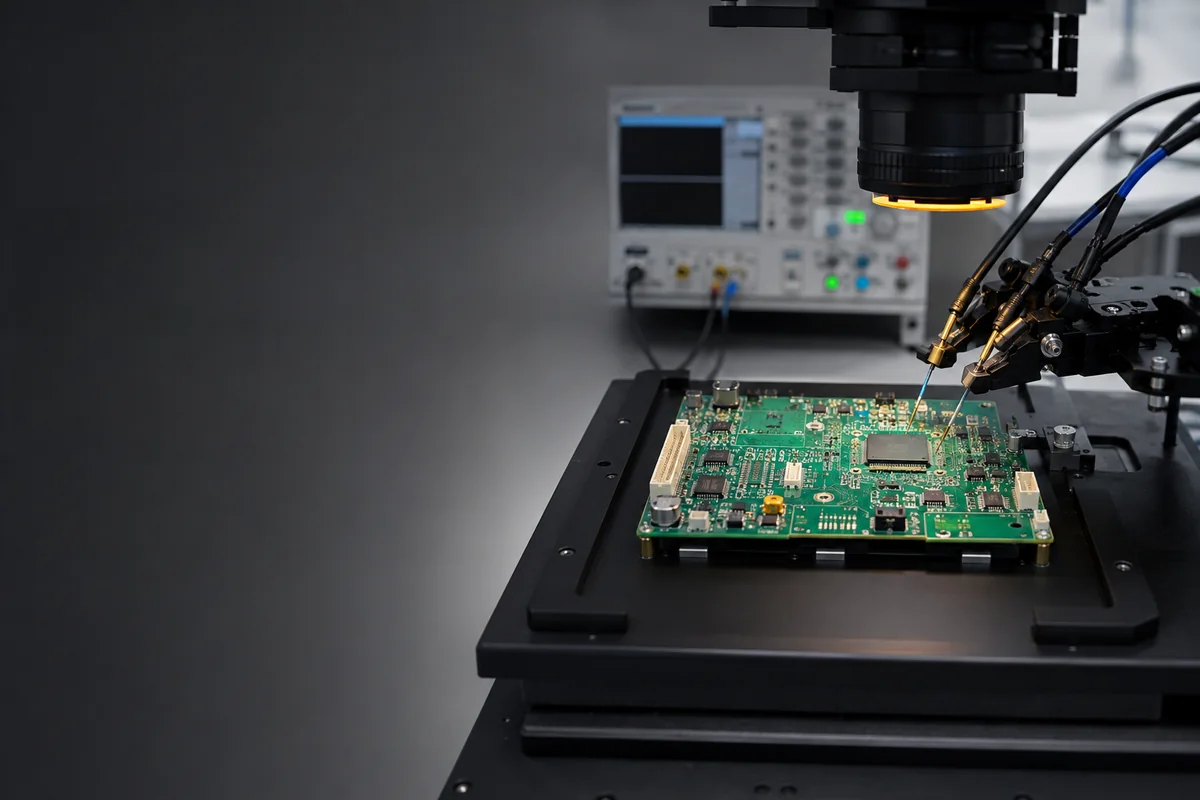
PCB assembly testing services should define the question each method answers, the board and firmware revision, fixture and software ownership, measurable limits, coverage, retained evidence, and failure disposition. Visual inspection, AOI, X-ray, connectivity tests, ICT or flying probe, programming and functional testing provide different evidence. Availability and exact coverage are confirmed with the selected partner for the actual design.
Match test evidence to the failure you need to detect
No single method establishes complete assembly quality or product function. Use the minimum combination that closes the relevant evidence gaps.
| Method | Useful for | Required definition | Important limit |
|---|---|---|---|
| Visual inspection | Identity, orientation, damage and visible workmanship | Areas, lighting/magnification and acceptance basis | Cannot evaluate hidden joints or full electrical behavior |
| AOI | Repeatable imaging of programmed visible conditions | Coverage, program, reference and review rule | A visible pass is not a functional test |
| X-ray | Selected hidden joints, alignment or voiding questions | Targets, views, sample coverage and acceptance criteria | An image without an interpretation rule is not acceptance evidence |
| Continuity / shorts | Defined nets, rails or safe pre-power checks | Access, stimulus, expected values and safety constraints | May not identify component performance or intermittent behavior |
| ICT / flying probe | Accessible net and component checks where program economics fit | Test access, coverage, program, limits and fixture/probe route | Availability and coverage depend on design and partner |
| Functional test | Defined product behavior, interfaces, loads and operating limits | Fixture, firmware, procedure, expected results and failure rules | The assembler cannot invent product acceptance from a schematic |
A test name is not a test specification
For a commercial quotation, each method needs entry conditions, execution responsibility and an output the customer can interpret.
Link the test plan to PCB revision, assembly variant, BOM, firmware and any approved deviation. Results are weak evidence when they cannot be tied to the manufactured unit.
State who designs, purchases, maintains, stores and owns fixtures, cables, adapters and golden samples. Define what happens after an engineering change.
Record test-software and firmware versions, programmer settings, credentials or keys, serialization input and the verification method. Protect sensitive assets while making them available at the required milestone.
Use measurable expected values, tolerances, conditions and sample or unit coverage. “Power on and test” does not define a reproducible acceptance decision.
Agree whether a failed unit is stopped, diagnosed, reworked, retested, segregated or returned, and who can approve use-as-is or a changed criterion.
Increase control as the decision changes
A prototype test may prioritize diagnosis and design learning. A low-volume release needs repeatable execution, unit identity and clearer disposition because more material and field exposure are at risk.
Prototype testing should separate failure categories
When a first build does not work, the team needs evidence that distinguishes assembly, design, part, firmware and fixture causes. Accessible measurements, logs and retained samples may be more valuable than a single pass lamp. See prototype PCB assembly for engineering validation.
First-article review should precede the full-batch assumption
Define which identity, workmanship, programming or functional results authorize continuation. First article is not a guarantee that every later unit is conforming, but it can catch a systematic interpretation error before the remaining batch is completed.
Test records should support the next decision
A useful record can identify unit or lot, hardware and firmware revision, method and software version, measured result, operator or station where relevant, and disposition. Retain only the data the project needs, but define it before quotation.
Inspection and functional evidence are complementary
A visually acceptable assembly may still contain a wrong value or functional defect; a product that powers on may still contain a workmanship issue. The testing methods guide and functional test fixture checklist help the customer prepare the technical inputs.
Define the result before asking for a price
The selected manufacturing partner can quote execution only after the intended coverage and customer-supplied assets are clear.
Expected response
Inputs, loads, interfaces, power conditions, sequence, measurable outputs, tolerance and duration.
Fixture and software
Fixture drawings or requirements, cables, adapters, test application, golden sample and maintenance responsibility.
Controlled image
Binary identity, target revision, programmer, settings, security material, serialization and verification.
Coverage and records
Every-unit or sampled execution, data fields, images/reports where needed, failure analysis and retest rules.
Capability status: AOI, X-ray, ICT, flying probe, programming and FCT are not presented as universal services. Cyrionix confirms method availability, access and deliverables for the selected partner and board.
Questions that turn a test name into a test scope
Clear inputs, limits and failure disposition are required before any inspection or functional test can produce useful acceptance evidence.
What testing is normally used for prototype PCB assembly?
Start with assembly identity and visible workmanship, then add safe electrical checks, firmware verification and functional tests that address the prototype objective. Hidden-joint inspection or other methods should be selected for specific package and failure risks.
Does AOI replace functional testing?
No. AOI checks programmed visible conditions. Functional testing evaluates defined electrical or product behavior. They produce different evidence and may both be appropriate.
Who provides the PCB functional test fixture?
The customer may provide a proven fixture, commission one, or ask the manufacturing team to quote fixture development. Ownership, design inputs, validation, storage, maintenance and engineering-change responsibility must be agreed.
Can X-ray inspection prove a BGA is electrically good?
X-ray can provide evidence about selected hidden-joint conditions, but it does not by itself prove electrical function. Image views, sample coverage and acceptance criteria should be defined.
What happens when a board fails functional test?
The agreed disposition may include segregation, repeat test, diagnosis, controlled rework or return for engineering review. The quotation should identify included effort, retained evidence and the person authorized to approve the next action.

Quote a defined test result
Share the board revision, target failures, firmware, fixture status, limits and reporting needs for a partner-specific test review.