
PCB Functional Test Fixture Requirements and Readiness Checklist
Release the hardware, firmware, sequence, limits and result rules needed to scope a repeatable functional test with an assembly partner.
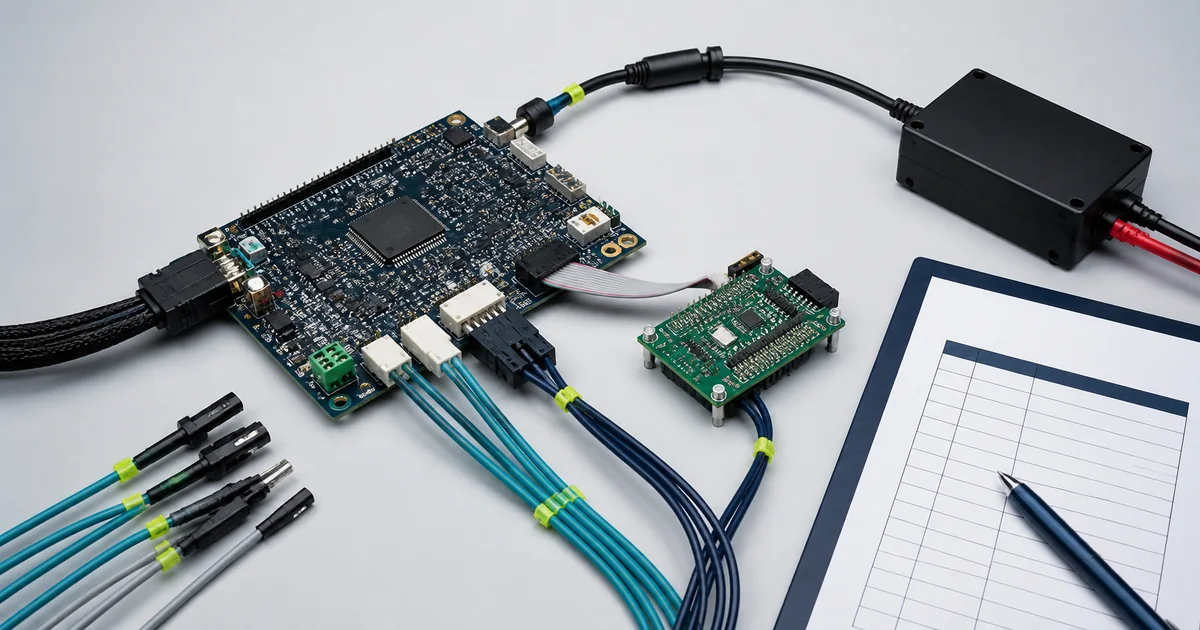
Define interfaces and safe power, fixture connections, controlled firmware, programming steps, test sequence, expected results, pass/fail limits, logging and failure disposition before asking a partner to perform functional testing.
A fixture is only one part of the test system
The fixture provides repeatable physical and electrical access. The product team must still define safe power, firmware, sequence, expected results, limits, data handling and failure disposition. A golden unit can support correlation but should not replace documented acceptance criteria.
Functional Test Readiness Checklist
| Input | What to release | Owner | Hold condition |
|---|---|---|---|
| Board identity | Assembly number, revision, fitted variants and test configuration | Hardware / configuration owner | Test target is ambiguous |
| Interfaces and access | Connector/pad map, mating parts, pinout, keep-outs and mechanical access | Hardware / test engineering | Required signal or control is inaccessible |
| Power | Nominal rails, current limit, sequencing, polarity and safe shutdown | Hardware engineering | Unsafe or undefined energization |
| Fixture concept | Location/alignment, contact method, cable set, replaceable wear items and drawings | Test engineering with partner | Repeatable connection cannot be confirmed |
| Firmware / programming | Controlled binary, version, checksum, tool/instructions, keys handling and verification | Firmware owner | Image identity or authorization is unresolved |
| Test sequence | Ordered setup, actions, stimuli, measurements and cleanup | Test engineering | Operator must infer steps |
| Expected results | Units, nominal value, tolerance, timing window and allowed state | Design owner | Pass/fail cannot be calculated |
| Logging / serialization | Fields, serial source, file format, storage/retention and trace relationship | Quality / operations | Results cannot be associated with a unit |
| Reference unit | Known configuration, calibration/correlation purpose and custody | Design / quality owner | Golden unit is undocumented or treated as sole criterion |
| Failure disposition | Retest limits, debug boundary, quarantine, evidence and escalation path | Quality / project owner | Failures can be repeatedly retested without control |
From programming to recorded result
Control
Release one approved firmware image, instructions and identity evidence.
Connect
Use documented power, interfaces, fixture alignment and safe limits.
Execute
Run an ordered sequence with explicit stimuli, measurements and tolerances.
Record
Tie pass/fail, versions, values and exceptions to the correct unit and revision.
RFQ package questions
- Is programming required, and who supplies tools, licenses or protected keys?
- Does the request require continuity, functional behavior or both?
- Who designs, owns, validates, stores and maintains the fixture?
- What result files or labels must be returned with the batch?
- What debug work is in scope after a failure, and who authorizes it?
Confirm capability per project
Functional testing ranges from a simple powered check to a software-controlled system with fixtures, instrumentation and traceability. Share the readiness package before expecting a partner to confirm feasibility, cost or schedule.
The presence of this guide does not mean every programming method, interface, fixture or functional test is available through every Cyrionix partner.
Sources and scope
- Keysight PCBA manufacturing test use case — ICT, programming, functional test, fixtures and manufacturing data context.
- Keysight parallel test systems — examples of configurable ICT/FCT/programming systems; not Cyrionix capability evidence.
Continue the decision path
Use the related service and engineering guides to define the project scope before quotation or release.
Need a project-specific review?
Share the released files, quantity, open decisions and required evidence.