
How to Reduce PCB Assembly Cost Without Increasing Manufacturing Risk
Reduce avoidable setup, purchasing and coordination cost before removing verification or accepting uncontrolled material decisions.
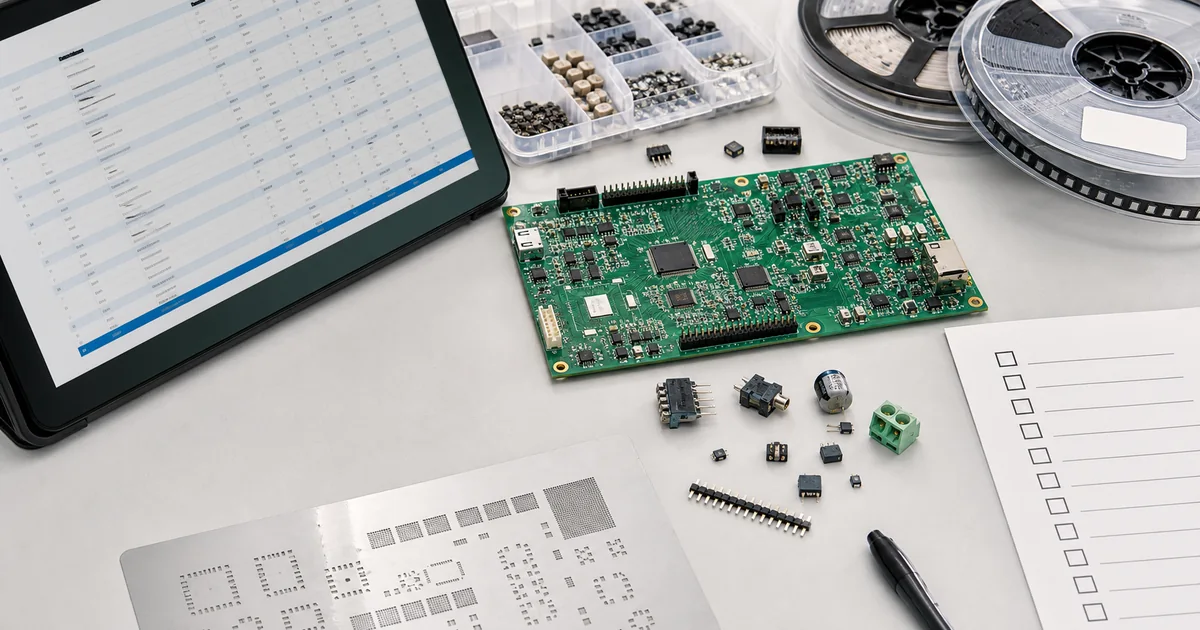
The lowest-risk cost reductions come from clearer manufacturing data, exact part identities, faster approval paths, realistic quantities and an explicit test scope. Removing inspection, accepting an undocumented substitute or comparing quotes with different inclusions may lower a visible line item while increasing rework, delay or repeat-build risk.
Cost Reduction vs Manufacturing Risk Matrix
| Action | Potential cost effect | Manufacturing risk | Control to keep |
|---|---|---|---|
| Release one matching data package | Reduces clarification and avoidable setup rework | Low | Revision identifier across Gerber, BOM, CPL and drawings |
| Use exact manufacturer part numbers | Improves sourcing comparison and reduces ambiguity | Low | Approved alternates remain explicit |
| Combine realistic follow-on demand | May distribute setup and purchasing overhead | Low to medium | Do not buy beyond a stable revision or owned demand |
| Approve packaging or order-quantity options | May reduce break-pack or MOQ friction | Medium | Record excess ownership and shelf/lifecycle exposure |
| Simplify test scope from defect evidence | Can remove unnecessary steps | Medium | Retain coverage for known failure modes and product risk |
| Accept a substitute only because it is cheaper | May reduce material cost | High | Engineering review of form, fit, function, lifecycle and firmware impact |
| Remove inspection without a replacement control | Reduces a quoted line item | High | Document why the remaining evidence is sufficient |
| Choose the lowest total without matching scope | Creates an apparent saving | High | Normalize materials, setup, verification, logistics and exclusions |
Why quantity and setup must be reviewed together
Stencil, programming, tooling, machine preparation and engineering review are not repeated per placement. A larger quantity may spread these fixed activities, but buying more of an unstable revision can create obsolete inventory. Compare current learning needs with credible follow-on demand before changing quantity.
How components change the decision
Part price is only one component cost. MOQ, reel packaging, attrition, approved channels, lifecycle and excess ownership may matter more than a small unit-price difference. The safest lever is to improve part identity and approval speed, then evaluate alternatives with an engineering owner.
Quote actions that reduce avoidable cost
- Send one released file package and identify the revision in the RFQ.
- Separate required parts from customer-supplied and do-not-purchase items.
- State current quantity, expected follow-on demand and ownership of excess material.
- Define inspection, programming and functional-test coverage with pass criteria.
- Ask every supplier to list assumptions, exclusions, logistics and tax basis. Normalize them against a landed-cost framework for quote-specific inputs.
This framework does not claim that Cyrionix is the cheapest supplier and does not publish universal savings percentages. Actual cost changes depend on the design, quantity, sourcing model, selected partner and verification scope.
Continue the decision path
Continue with the related service and engineering guides for the current build stage.
Need a project-specific review?
Share the released files, BOM, quantity, open decisions and required verification scope.