How Component MOQs Affect Prototype and Low-Volume PCB Assembly
Direct answer: Component minimum order quantities affect prototype and low-volume PCB assembly when the quantity purchased is larger than the quantity consumed by the build. The difference becomes excess inventory, not additional assembled boards. Buyers should separate supplier MOQ, package multiple, expected attrition, per-board usage, and material ownership for each affected BOM line before comparing quotations.
What decision does this guide support?
This guide supports a commercial and engineering decision: whether to accept an MOQ, choose an approved alternate, consign material, change the build quantity, or postpone the purchase. The correct choice depends on how likely the design is to change and whether the excess can be used in a later revision. A low unit price does not reduce risk if most of the reel becomes obsolete after the first build.
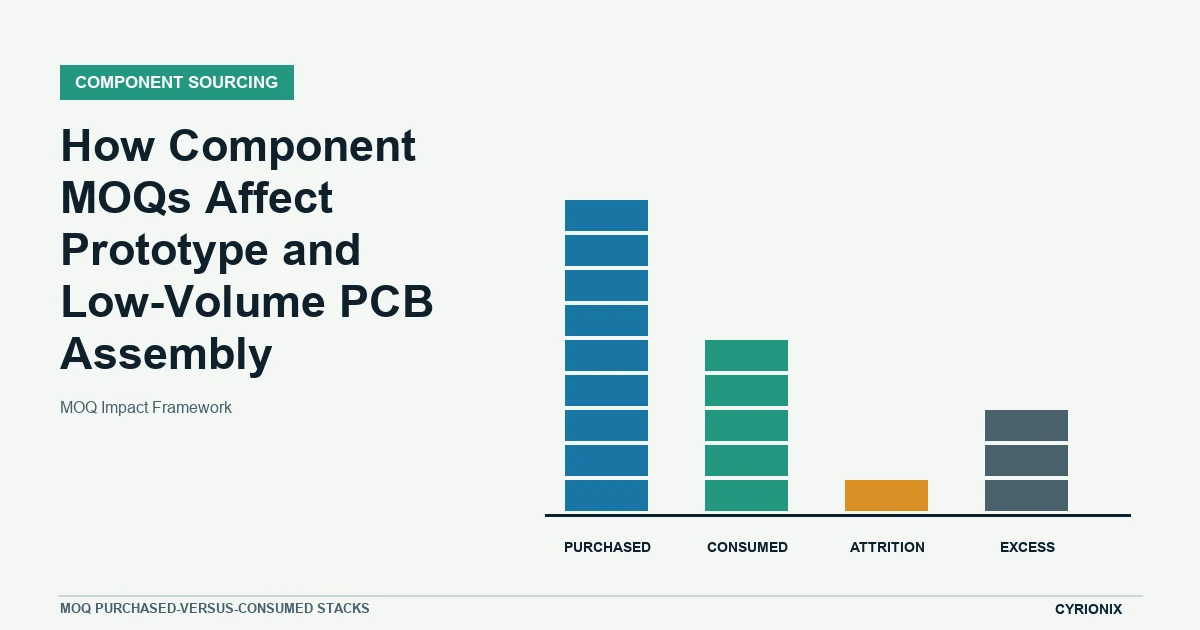
MOQ impact framework
The framework separates purchased quantity from consumed quantity. Apply it line by line to the components that materially affect cash exposure rather than averaging the effect across the entire BOM.
| Control point | Required action or evidence | Hold condition |
|---|---|---|
| Purchased quantity | Capture supplier pack size and MOQ for each line. | Quote totals show only consumed quantity. |
| Consumed quantity | Calculate per-board usage, build quantity, expected attrition, and panel basis. | The usage basis cannot be reproduced. |
| Excess | Show purchased minus expected consumed material by line. | Excess is hidden inside a lump-sum BOM price. |
| Ownership | Agree whether excess is returned, stored, transferred, or disposed. | Material liability is deferred until delivery. |
| Revision risk | Estimate whether excess survives likely BOM or PCB changes. | Buying more increases obsolete exposure. |
| Lifecycle risk | Balance MOQ against availability, shelf handling, and future demand confidence. | A speculative buy is treated as guaranteed savings. |
MOQ is a purchasing constraint, not a build quantity
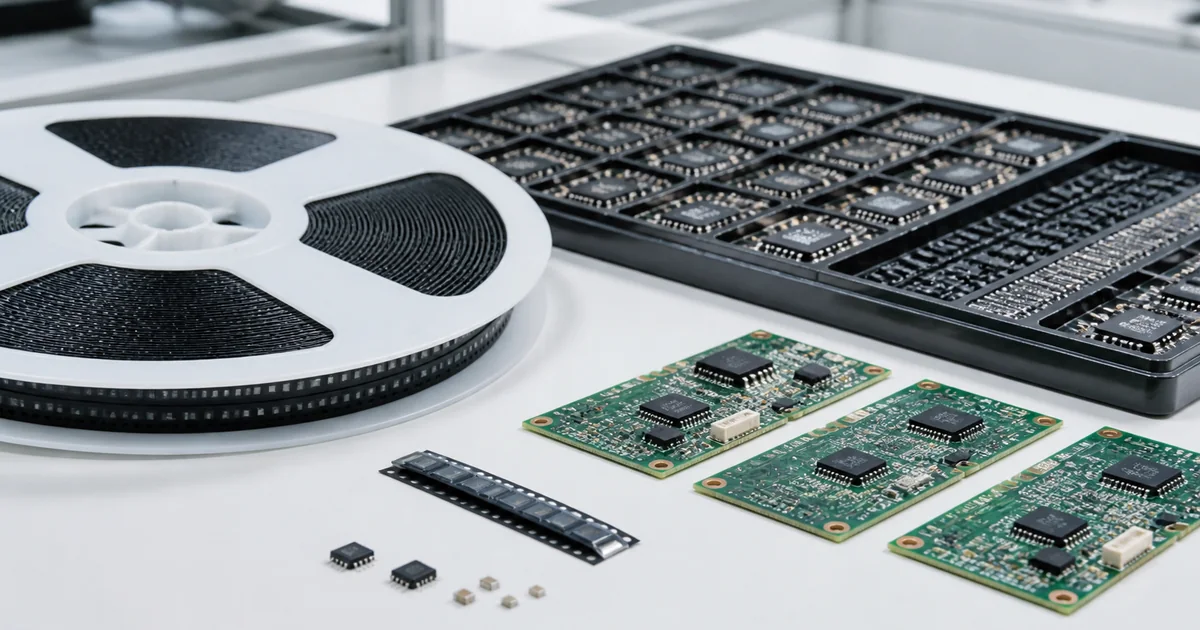
A supplier may sell a full reel, tray, tube, or factory pack even when the assembly needs only a fraction of it. The assembler can still build the requested number of boards, but the quote must account for the complete purchase. Confirm whether the stated MOQ comes from the manufacturer, distributor, broker, or the assembler’s own handling policy because those are different constraints.
Account for packaging and process attrition
Purchased quantity should cover the exact package multiple and a reasonable setup or handling allowance. Attrition is not a universal percentage: it varies with package type, feeder setup, manual operations, and the ability to return unused material to controlled packaging. Ask for the basis when an allowance has a meaningful cost impact.
Calculate the excess by orderable part number
For each line, calculate required placements as quantity per board multiplied by build quantity, then add the agreed allowance and round to the purchasing multiple. Subtract expected consumption from the purchased quantity to expose excess. Keeping this calculation at MPN level avoids masking a costly reel behind the average BOM price per assembly.
Decide who owns and stores remaining material
The quotation should state whether excess will be returned, stored for a repeat order, transferred to the customer, or disposed of with approval. Storage has practical conditions: moisture-sensitive devices may require sealed packaging and exposure records, while traceability labels must remain associated with the material. Do not assume that “customer-owned” inventory automatically includes indefinite free storage.
Measure revision risk before buying ahead
Excess has value only if the same orderable part remains valid for a future build. Review likely schematic changes, footprint changes, firmware dependencies, and product variants before increasing the buy. Prototype programs with unstable power, radio, sensor, or connector choices usually deserve a more conservative commitment than a released repeat build.
Balance lifecycle risk against inventory risk
A last-time-buy or constrained component may justify purchasing more than the immediate requirement, but that is an explicit risk decision. Record forecast confidence, approved applications, shelf-life or handling needs, and the cost of redesign. Availability data can change quickly, so preserve the date and source of the evidence used for the decision.
How to review MOQ exposure in a quotation
- Filter the BOM. Identify lines where MOQ, pack size, or unit value creates material excess.
- Reconcile the math. Compare requested boards, placements per board, allowance, purchased quantity, and expected balance.
- Assign disposition. Approve the buy only after ownership, storage, future use, and obsolete-material responsibility are clear.
MOQ questions from prototype buyers
Can an assembler buy cut tape instead of a full reel?
Often, but not for every part or source. Cut tape can reduce excess while changing price, traceability, feeder preparation, or available quantity. The purchasing option should be evaluated against the approved source and assembly plan rather than assumed.
Should we increase the board quantity to use the MOQ?
Only when the extra boards have a defined use and the design is stable enough to justify them. Building unwanted assemblies merely converts excess components into higher-value excess finished goods.
How should excess material appear on a quote?
The clearest presentation names the affected MPN, purchased quantity, expected consumption, expected remainder, and ownership. A separate excess-material line or reconciliation schedule is easier to audit than a blended per-board surcharge.
Related Cyrionix resources
The PCB component sourcing guide explains source and approval controls. For a broader quotation review, use the PCB assembly cost-driver guide.
Technical references
- Altium ActiveBOM verification documentation
- Altium substitute-component documentation
- Altium design-variant documentation
Need an MOQ review? Send the BOM and target quantity for a component-sourcing scope review.