Revision Control for Low-Volume PCB Assembly: Avoiding Mixed Builds
Direct answer: Prevent mixed low-volume builds by releasing one dated manufacturing package, naming the batch in which each change takes effect, and blocking access to superseded files. BOM substitutions, firmware, test instructions, labels, and old stock must follow the same revision decision.
What decision does this guide support?
This guide is for hardware and operations teams introducing changes between small production batches. It shows how to decide when a change is ready, what happens to existing material, and which records must connect every finished unit to the effective revision.
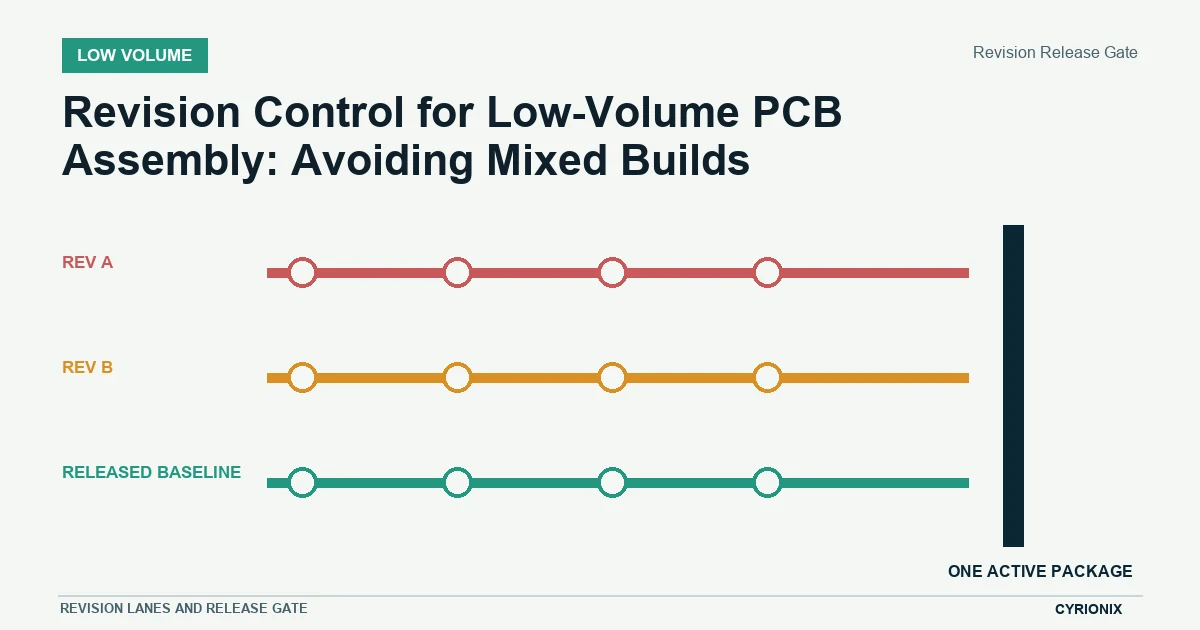
Revision Release Gate
Review all six gates before releasing a changed batch. A hold condition means the package is not ready, even if fabrication or purchasing could otherwise begin.
| Checklist item | Required evidence | Hold condition |
|---|---|---|
| Change request | Describe the reason, affected items, urgency, and requested effective batch. | The change exists only in email fragments. |
| Impact review | Check PCB, BOM, CPL, drawings, firmware, test, packaging, and stock. | Any affected domain lacks an owner. |
| Material disposition | Decide use-as-is, rework, return, quarantine, or scrap for old stock. | Old and new material could enter the same batch. |
| Package release | Issue one dated baseline with superseded files removed from the active path. | Manufacturing can still access multiple approved-looking packages. |
| Acknowledgement | Require engineering, sourcing, manufacturing, and test to confirm the baseline. | A handoff party has not acknowledged the change. |
| Batch identity | Link purchase order, work record, firmware, test results, and labels to revision. | Finished units cannot be traced to the effective revision. |
Why revision control becomes harder in small batches
Small batches often change faster than formal production systems: one email updates the BOM, another changes firmware, and remaining stock still reflects the prior build. A written change request creates one starting point and states the first batch to which the change applies.
Define the manufacturing baseline
Review the PCB data, BOM, CPL, drawings, firmware, test instructions, packaging, and inventory as one package. Assign an owner to every affected area so that a seemingly local change does not leave another document or process behind.
The six release gates
The gates move from defining the change to tracing the finished units. Material disposition is especially important in low-volume work because a few old components or labels can quietly create a mixed batch.
How to handle approved substitutions
Record an approved substitute against the exact BOM revision, manufacturer part number, quantity, and effective batch. Release a new dated package and remove superseded files from the active manufacturing path instead of relying on an approval buried in email.
Batch records and feedback for the next revision
Engineering, sourcing, assembly, and test should acknowledge the same baseline before work starts. Build feedback then returns to that baseline, making the next order a controlled continuation rather than a reconstruction from memory.
Revision-control checklist
Before release, confirm the change request, impact review, old-stock disposition, package date, stakeholder acknowledgements, and batch identity. The purchase order, work record, programmed firmware, test evidence, and labels should all point to the same revision.
Apply the controls to the next batch
- Name the effective batch. State which purchase order or lot first uses the change.
- Quarantine ambiguity. Separate old stock and remove superseded files before release.
- Close the record. Link deviations, rework, test results, and shipped units to the released baseline.
Related Cyrionix resources
Continue with the low-volume PCB assembly service and release-package guides for the next controlled batch.