Design for Availability Before PCB Layout Freeze
Direct answer
Design for availability means treating a component’s supply path as a design input before the PCB layout is frozen. It does not mean selecting the part with the largest public stock count. Review lifecycle, approved sources, package constraints, functional dependencies and alternate strategy early, then record who can approve each change if availability moves.
Availability is an engineering constraint
The schematic defines electrical intent, but the BOM determines whether that intent can be purchased, assembled and repeated. A part can be technically ideal and still create an avoidable schedule risk when it is sole source, near end of life, available only in an unsuitable package, or missing an approved alternate.
That risk is not solved by adding a second manufacturer name to a spreadsheet. The alternate must fit the board, behave correctly in the circuit and preserve the project’s firmware, test and compliance assumptions.
ECIA’s July 2026 Industry Pulse provides a current reason to run this review: 82% of participants reported increasing lead-time pressure, and all semiconductor respondents in that month’s survey reported increasing pressure. This market signal justifies a fresh BOM review. It does not identify which specific MPN is safe or risky.
The layout-freeze availability gate
| Gate | Required evidence | Decision | Hold condition |
|---|---|---|---|
| Exact identity | Full MPN, suffix, package and temperature or qualification option | The intended part is unambiguous | Purchasing would need to interpret the description |
| Lifecycle | Current manufacturer product status and dated review | Lifecycle fits the planned product horizon | Status is unknown or based only on a marketplace listing |
| Source | Approved channel and source rule | The project knows where parts may be purchased | Any available seller can be used without approval |
| Package | Land pattern, pinout, orientation and assembly constraints | The chosen package is manufacturable for this design | Package or footprint confirmation is incomplete |
| Functional dependency | Critical electrical, timing, thermal, firmware and test attributes | Controlled attributes are named | The team cannot state what must remain unchanged |
| Alternate plan | Approved alternate, layout provision or explicit redesign path | A supply change has a controlled response | “Equivalent” means only a similar description |
| Ownership | Named engineering and purchasing approvers | Exceptions have an escalation path | The assembler or buyer must infer approval authority |
This gate should finish before the layout decision becomes expensive to change. It can be repeated at release when the sourcing snapshot is refreshed.
Classify every BOM line by dependency
Do not apply the same review depth to every resistor and processor. Classify the line by what would happen if it changed.
Footprint-locked
The design accepts only one package or pinout. A shortage may require layout work. Record the reason for the lock and whether a second footprint strategy was evaluated.
Function-locked
The footprint may be common, but electrical behavior, firmware, timing, thermal performance or qualification requirements narrow the acceptable choices. Define the controlled attributes explicitly.
Source-controlled
Multiple manufacturers may work, but the project requires an approved source, traceability or date-code rule. Record the sourcing boundary separately from the electrical specification.
Commodity with controlled envelope
Several parts may be acceptable if value, tolerance, voltage, dielectric, package and other relevant limits remain within a documented envelope. The envelope must be engineering-approved; it is not a purchasing guess.
Four alternate strategies
1. Approve a true form-fit-function alternate
Use this only when the comparison shows that package, pinout and required behavior remain acceptable. Document the compared attributes and the validation needed after the change.
2. Design one footprint for multiple approved packages
This can reduce sourcing exposure, but only when the combined land pattern and assembly process remain reliable. A visually compatible footprint is not automatically a manufacturable one.
3. Isolate the dependency in a module
A module or replaceable subassembly may contain a volatile compute, radio or memory dependency. This can simplify the carrier board, but it transfers risk to module lifecycle, connector availability and software support.
4. Accept a documented single-source risk
Some designs genuinely require one component. Make the decision visible: name the business reason, review trigger, inventory policy and redesign lead time. Hidden single-source risk is the problem; a deliberate decision may be reasonable.
Worked example: same package, different decision
This is a hypothetical engineering example, not a Cyrionix customer result.
A board uses a power-management IC in a common QFN package. A second device has the same body size and nominal voltage range. It is not yet an approved alternate.
| Check | Finding | Result |
|---|---|---|
| Pinout | Two pins have different functions | Not form-fit-function |
| Enable threshold | Different startup behavior | Firmware and sequencing review required |
| Thermal pad | Same body size but different exposed-pad recommendation | Footprint and thermal review required |
| Output behavior | Different current-limit response | Functional validation required |
| Public stock | Alternate currently shows more stock | Useful sourcing signal, not approval evidence |
The correct outcome is not “use the available one.” It is either redesign and validate the alternate, keep the original part with a sourcing plan, or choose another architecture before layout freeze.
What to record in the BOM
Add structured fields rather than long free-text notes:
- manufacturer and exact MPN;
- lifecycle review date and source;
- approved source rule;
- dependency class;
- controlled attributes;
- approved alternate MPN;
- alternate approval reference;
- approval owner;
- revalidation trigger;
- affected design revision.
These fields connect engineering intent to purchasing action. They also help an assembler distinguish a buyer-approved range from a suggestion that still needs approval.
What this process does not prove
An approved alternate does not prove that every future lot will be available. A multi-source BOM does not eliminate counterfeit, allocation or lifecycle risk. A public distributor snapshot does not reserve inventory. The process creates explicit decisions and faster response paths; it does not promise uninterrupted supply.
How Cyrionix uses the boundary
Cyrionix can coordinate a BOM and sourcing review with manufacturing partners, but functional substitution authority remains with the customer’s authorized engineering owner. Source, MOQ, traceability, lifecycle, inspection and test requirements must be confirmed for the actual project and quotation.
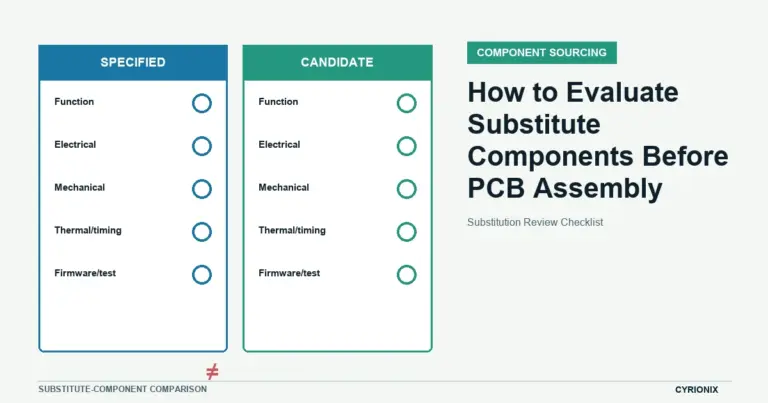
Use the Component Sourcing service for project-specific scope. The scheduled guide How to Evaluate Substitute Components Before PCB Assembly covers the later decision for one proposed replacement.
Frequently asked questions
Should every component have a second source?
No. Some parts have no credible second source, and forcing one can increase technical risk. Classify the dependency, make the single-source decision explicit and define the response if availability changes.
Does pin compatibility make a component an approved alternate?
No. Review the electrical, timing, thermal, firmware, qualification, lifecycle and test attributes relevant to the circuit. Pin compatibility is one check, not the decision.
When should availability be reviewed?
Review it before layout freeze, at manufacturing release, when a quote expires, when a manufacturer changes product status, and before a repeat build that relies on old sourcing evidence.
Can a contract manufacturer approve alternates?
The manufacturer can identify candidates and provide sourcing or process evidence. Functional engineering authority should follow the buyer’s documented approval rule.
Sources
- ECIA Industry Pulse public summaries
- ECIA July 2026 Industry Pulse executive summary
- Altium substitute-component documentation
- Altium ActiveBOM verification documentation
Request a project-specific PCBA review after the revision, quantity, evidence and open decisions are defined.