Electronic Component Lead Times in 2026: Recheck Your PCBA BOM Before Release
Direct answer
Electronic component lead-time pressure increased in July 2026, according to ECIA’s survey of authorized-channel participants. That does not mean every part is scarce. It means a hardware team should not release a PCBA build from an old stock screenshot or an expired quote. Revalidate each critical line, its approved source, MOQ, alternate status and decision owner first.
A stronger market does not make your BOM safer
ECIA’s July 2026 Industry Pulse reported a 12-percentage-point increase in respondents seeing rising lead-time pressure, bringing the overall share to 82%. All semiconductor respondents in that month’s survey reported increasing lead-time pressure. At the same time, ECIA’s broader component sentiment index remained above its prior-12-month average.
Those two findings can coexist. Demand and confidence may be healthy while the time needed to secure a particular component becomes less predictable.
For a PCBA buyer, the practical question is not whether the entire electronics market is in a shortage. It is narrower:
Can this exact BOM, for this quantity and build date, be bought from approved sources under the assumptions used in the quotation?
The answer can change between quotation and purchase-order release. A distributor stock page is a snapshot, not a reservation. A quoted lead time is not the same as confirmed allocation. An available substitute is not automatically an approved substitute.
What the July 2026 signal does and does not prove
| The survey supports | The survey does not prove |
|---|---|
| Lead-time pressure was more widely reported by July participants than in June. | Every semiconductor or passive component has a long lead time. |
| Semiconductor respondents in this survey were uniformly seeing increasing pressure. | A specific MPN will be unavailable when your order is placed. |
| A dated BOM and quote review is justified before release. | Buyers should panic-buy, accept an unapproved source or redesign every board. |
| Sourcing conditions should be monitored as part of build control. | One universal price increase, MOQ or lead time applies to all PCBA projects. |
This distinction matters. Market commentary can tell you when to investigate. Only line-level sourcing evidence can tell you what to do with your build.
Revalidate the BOM in seven passes
1. Confirm the exact manufacturer part number
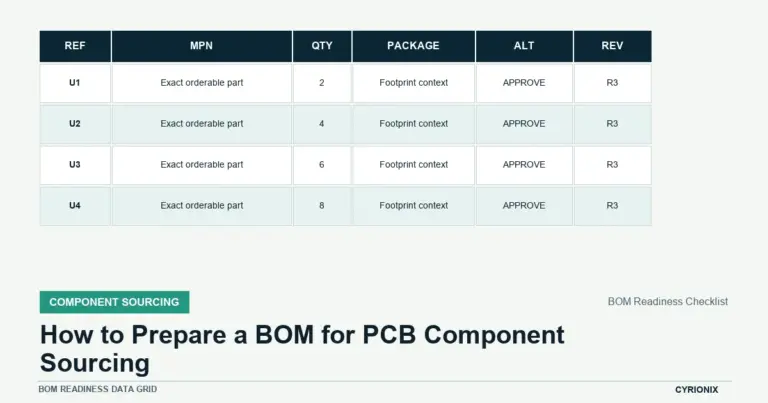
Descriptions such as “10 uF capacitor” or “3.3 V regulator” do not define a purchasable production part. Each fitted line should identify the manufacturer, full manufacturer part number, package and any controlled option that affects form, fit or function.
Check for:
- incomplete suffixes or temperature grades;
- package variants that share a base part number;
- BOM lines that specify only a distributor SKU;
- footprints that no longer match the intended package;
- do-not-populate parts that are not clearly marked in both the BOM and placement data.
The goal is not to make the spreadsheet look complete. It is to remove interpretation from purchasing and placement.
2. Date every availability claim
Record when stock, lead time and price were checked, by whom and at which source. A useful record says:
Checked 2026-08-12, authorized source A, 2,480 units shown, no allocation confirmed.
An unhelpful record says:
In stock.
For critical parts, separate three states:
- visible stock;
- quoted or reserved stock;
- purchased stock with an acknowledged order.
They are not interchangeable. A build should not be scheduled as though state 1 were state 3.
3. Recalculate MOQ, order multiples and excess
A component can be available and still distort the build economics. For each line, compare required quantity with minimum order quantity, reel or tray multiple, attrition allowance and any supplier packaging constraint.
Ask who owns material left after the build:
- the buyer;
- the assembler;
- the sourcing partner;
- or nobody, because the quotation did not define it.
That last answer creates avoidable disputes. Excess ownership, storage period, reuse approval and return terms should be visible before release. For a broader comparison of purchasing responsibility, see Turnkey vs Consigned PCB Assembly.
4. Separate a possible alternate from an approved alternate
A similar data-sheet headline is not an engineering approval. Before an alternate enters the production BOM, evaluate the attributes that matter to the circuit and assembly process. Depending on the part, these may include:
- package and land pattern;
- pinout and pin function;
- absolute maximum ratings and operating range;
- electrical behavior under the actual load;
- timing, firmware, register or boot implications;
- qualification grade and lifecycle status;
- moisture-sensitivity level, storage and handling;
- test coverage needed after the change.
Assign an approval owner and record the evidence. If the alternate changes form, fit, function, firmware or compliance assumptions, it is not a purchasing-only decision.
5. Reopen the quote when an assumption changes
A PCBA quote is a model built from assumptions: BOM revision, quantity, selected sources, board specification, assembly process, inspection, testing, packaging, shipping and quote-validity period.
Requote when any material assumption changes. Common triggers include:
- a BOM revision or fitted-quantity change;
- a critical MPN moving from visible stock to lead-time supply;
- an alternate requiring engineering review;
- a different order quantity or batch split;
- a new MOQ or packaging multiple;
- a change from turnkey to consigned material;
- an expired component-price or freight-validity window.
Do not compare a current quote with an old quote only by total price. Normalize scope first. PCB Assembly Cost Drivers explains the manufacturing cost layers; the BOM review here addresses whether current sourcing assumptions are still valid.
6. Identify schedule anchors, not just expensive parts
The most expensive line is not always the part that controls the schedule. Mark any component that is:
- sole source;
- on allocation;
- purchased only in a large multiple;
- sensitive to date code or traceability requirements;
- supplied by the buyer;
- firmware dependent;
- unavailable from an approved source;
- or required before test software or fixtures can be finalized.
Then build the schedule around the latest credible availability of those anchors. A generic “all parts ready” date hides the dependencies that are most likely to move.
7. Freeze the evidence with the released revision
At release, save the approved BOM together with the sourcing snapshot and decision record. At minimum, retain:
- BOM revision and release date;
- manufacturer and MPN for every fitted line;
- approved source or sourcing rule;
- availability check date;
- MOQ and order multiple;
- approved alternate and approval reference, if any;
- buyer-supplied material status;
- unresolved exceptions and their owner;
- quote version and validity date.
This record lets the next build distinguish a controlled repeat from a new sourcing decision.
A worked example: the quote is valid, but the BOM is not ready
The following example is hypothetical. It shows the decision logic; it is not a Cyrionix customer result.
A hardware team requests 100 assembled boards. Each board uses one processor, two power ICs and 42 common passives. The assembly quote remains inside its validity period, but the processor stock screenshot is 18 days old. One power IC is available only in a 250-piece tray. An engineer has mentioned a pin-compatible substitute in email, but no comparison or approval is attached to the BOM.
| Line | Observed condition | Release decision | Required action |
|---|---|---|---|
| Processor | Old public stock snapshot; no reservation | Hold | Obtain a dated source confirmation or purchase acknowledgement |
| Power IC A | MOQ exceeds build demand | Conditional | Define excess ownership, storage and reuse terms |
| Power IC B | Possible alternate mentioned but not approved | Hold | Complete form-fit-function and test-impact review |
| Common passives | Approved values and packages available from multiple sources | Proceed with controls | Freeze approved manufacturer/source rules and attrition |
The correct response is not to cancel the build or redesign the board immediately. It is to close the three explicit decisions. Once those decisions are documented, the assembler can update price and schedule against a controlled input set.
Questions to send with the RFQ or purchase release
Use specific questions that can receive evidence-backed answers:
- Which BOM lines are priced from visible stock, quoted stock or lead-time supply?
- On what date was each critical availability assumption checked?
- Which sources are approved, and will source changes require buyer approval?
- Which lines have MOQ, reel, tray or order-multiple excess?
- Who owns unused material, and how long will it be stored?
- Which alternates are already approved in writing?
- Which parts currently anchor the assembly schedule?
- What event causes the component portion of the quote to be repriced?
- How will received part numbers, quantities and exceptions be recorded?
- What BOM revision will appear on the work order and build record?
These questions are more useful than asking whether a supplier “has good sourcing.” They define the evidence and ownership expected for this project.
Use a line-level worksheet
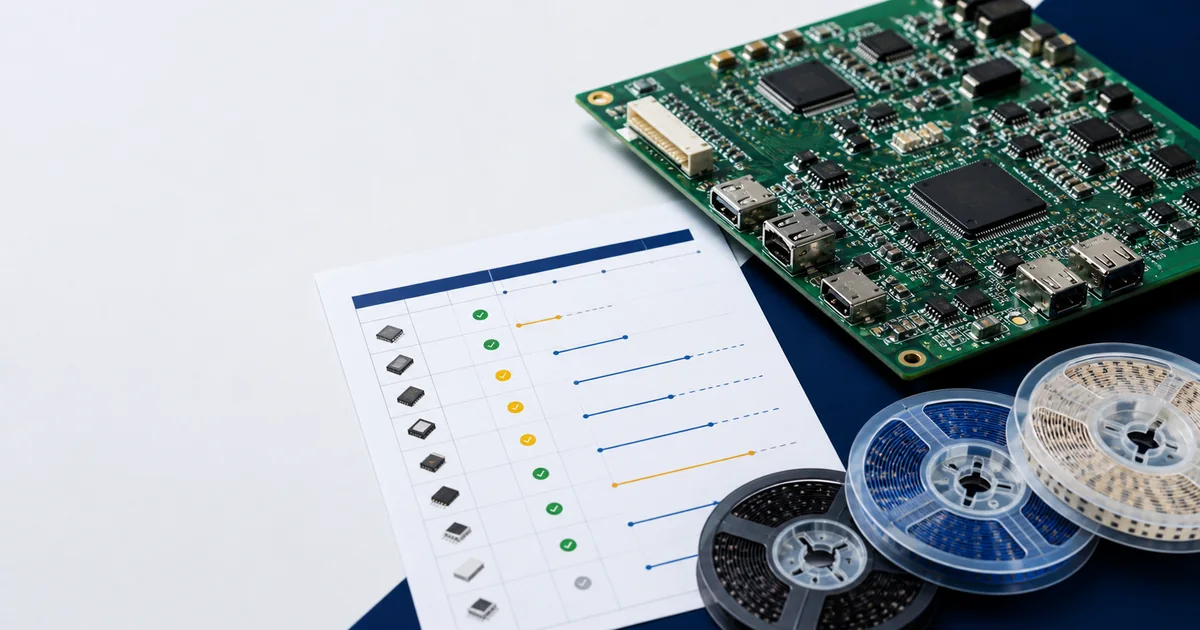
The companion BOM revalidation worksheet includes fields for:
- manufacturer and MPN;
- lifecycle status;
- approved source;
- dated stock and lead-time snapshot;
- MOQ and order multiple;
- price snapshot;
- approved alternate and approval owner;
- last engineering review;
- risk rating and required action.
Do not use the risk rating as an automatic purchasing decision. It is a way to make unresolved lines visible and assign an owner before release.
Download the PCBA BOM revalidation worksheet (CSV)
How Cyrionix handles the review boundary
Cyrionix coordinates quotation, engineering communication and build execution with manufacturing partners in Shenzhen. Component source, process capability, inspection, testing, MOQ and schedule remain project-specific and must be confirmed in the quotation and release record.
For a sourcing review, send:
- the revision-controlled BOM;
- Gerber and drill outputs;
- component placement data;
- assembly drawings and special instructions;
- target quantity and delivery location;
- approved-source, traceability and alternate-approval rules.
See the PCB Assembly Files guide for the broader manufacturing package. To start a project-specific review, use the Request a Quote form.
Frequently asked questions
Are all electronic component lead times increasing in 2026?
No. ECIA’s July survey indicates broader reported pressure, especially among semiconductor respondents, but it does not describe every MPN. Availability must be checked by exact manufacturer part number, approved source, quantity and date.
How recent should a component stock check be before PCBA release?
There is no universal number of days. Recheck critical parts at purchase release and whenever the quote, BOM, quantity, source or build date changes. Public stock should not be treated as reserved stock.
Should we buy long-lead parts before ordering the PCB?
Sometimes, but only after the design, package, source and revision risks are understood. Buying too early can strand expensive or incompatible inventory. Coordinate critical-part purchase with design freeze and change control.
Can an assembler choose substitute components automatically?
Only under an approval rule the buyer has explicitly accepted. Define which attributes are controlled, who can approve a change and what test evidence is required. A purchasing suggestion should not silently become an engineering release.
Does a turnkey quote eliminate component risk?
No. Turnkey sourcing centralizes purchasing responsibility, but it does not make stock, lifecycle, MOQ, traceability or alternates irrelevant. Those assumptions still need to be visible in the quote and release record.
Sources and review trigger
- ECIA Industry Pulse public summaries
- ECIA July 2026 Industry Pulse executive summary
- KiCad PCB Editor documentation
Review this article when ECIA publishes a new monthly summary, when a cited official source changes, or when Cyrionix’s approved sourcing workflow changes. Line-level part claims must be checked for each RFQ and must not be carried from this article into a quotation.
Request a project-specific PCBA review after the revision, quantity, evidence and open decisions are defined.