What to Send for a Turnkey PCB Assembly Quote
Direct answer: A turnkey PCB assembly quote needs more than Gerbers, BOM, and CPL. Include board requirements, purchasable part data, variants and quantities, sourcing authority, programming and test scope, packaging, destination, schedule assumptions, and responsibility for excess material.
What decision does this guide support?
This checklist helps buyers define the inputs that affect a full-scope turnkey price and schedule. It makes technical, purchasing, test, and delivery assumptions visible before the quotation is compared or accepted.
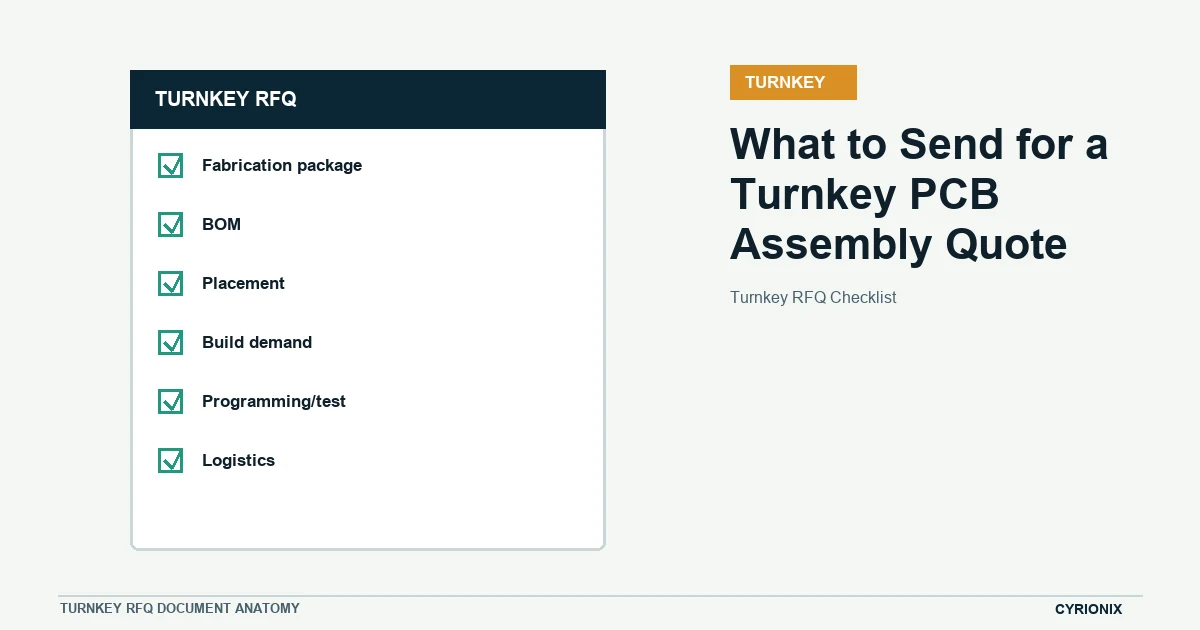
Turnkey RFQ Checklist
Send the available evidence for every row and identify unresolved items. The quotation should state how each open input was assumed rather than silently filling the gap.
| Checklist item | Required evidence | Hold condition |
|---|---|---|
| Fabrication package | Send Gerber/drill or agreed native data, stack-up, finish, outline, and drawings. | Board requirements require guessing. |
| BOM | Include manufacturer part number, quantity, DNP, alternates, and no-substitute rules. | A line is not purchasable as written. |
| Placement | Send reference, X/Y, rotation, side, origin, and assembly notes. | CPL and BOM population disagree. |
| Build demand | State batch quantity, variants, panel quantity basis, and lifecycle stage. | The supplier cannot determine consumed quantity. |
| Programming/test | Provide binary, method, fixtures, limits, expected evidence, and ownership. | Test cost and time cannot be scoped. |
| Logistics | State packaging, labels, destination, timing constraint, and excess-material disposition. | The quotation ends before the required delivery scope. |
Core fabrication and assembly files
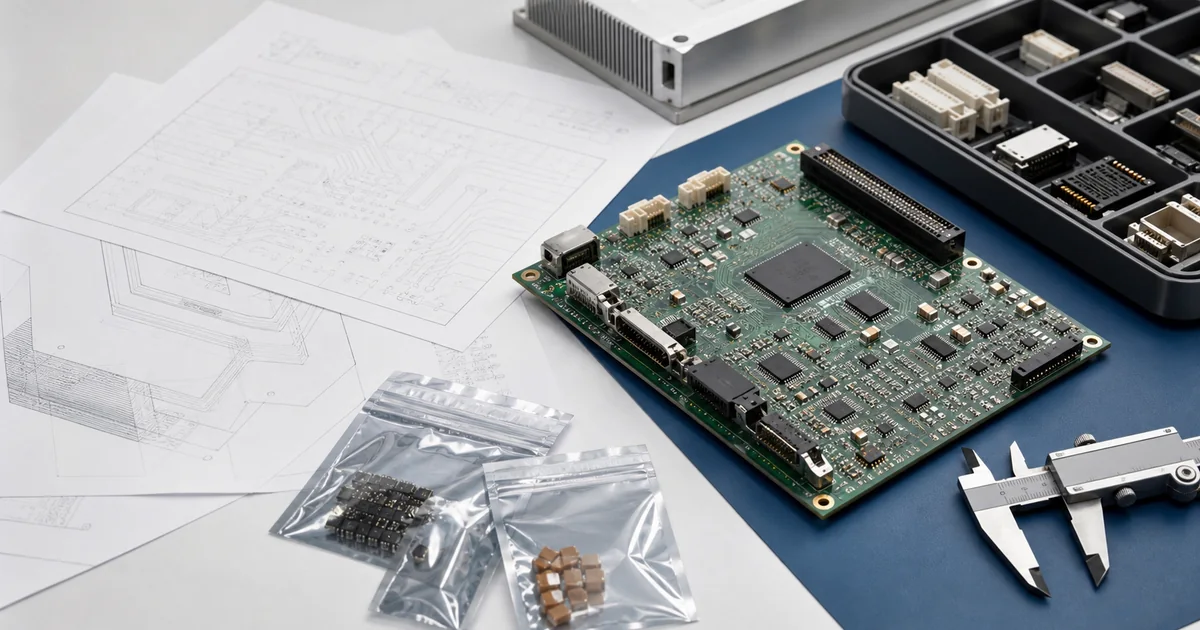
Provide Gerber and drill data or the agreed native format, stack-up, finish, dimensions, outline, drawings, BOM, and placement data under one revision. Confirm that the CPL, assembly drawing, and BOM describe the same fitted variant.
BOM sourcing instructions
Include manufacturer part numbers, quantities, do-not-install status, approved alternates, source or traceability controls, and no-substitute lines. A supplier should not have to infer which characteristics engineering considers interchangeable.
Quantities and build stage
State units per variant, panel or array assumptions, batch splits, expected repeat demand, and whether the build is prototype, validation, pilot, or replenishment. These inputs determine consumed quantity, setup allocation, and material exposure.
Programming and test
Provide controlled binaries, target devices, access method, fixtures, software, limits, expected data, and ownership. If test development is required, separate it from recurring execution and define the acceptance milestone.
Packaging and logistics
Specify labels, ESD or moisture requirements, packing format, destination, timing constraints, Incoterm needs, and disposition of excess material. The quoted delivery boundary should match the buyer’s comparison basis.
Turnkey RFQ checklist
Before submission, reconcile fabrication, BOM, CPL, build demand, programming and test, and logistics. Mark conditional items clearly and ask the provider to list exclusions, one-time charges, quote validity, and unresolved dependencies.
Package the RFQ for a useful first review
- Identify one revision. Keep fabrication, BOM, CPL, drawings, and variants aligned.
- Define purchasing authority. State source controls, alternate rules, and excess-material ownership.
- Complete the delivery boundary. Include test, packaging, destination, and commercial assumptions.
Related Cyrionix resources
Use the turnkey PCB assembly service and PCB assembly file guide when assembling the final RFQ package.