Prototype-to-Pilot PCBA Release Gates
Direct answer
A working PCBA prototype is ready for a pilot build only after the team closes the differences between engineering success and manufacturing repeatability. Freeze the revision, verify the bare-board and BOM assumptions, define process and first-article evidence, control firmware and test, then authorize the remaining batch through a recorded release decision.
Bench success and repeatable production answer different questions
A prototype asks whether the design can work. A pilot asks whether a defined revision can be built, inspected, programmed and tested repeatedly under controlled inputs.
That distinction matters because a successful prototype may rely on hand-selected parts, manual rework, laboratory power supplies, an engineer’s unwritten bring-up sequence or a one-time board lot. None of those conditions automatically transfers to the next setup.
A July 2026 engineering discussion on Reddit collected examples of failures appearing after good prototypes: changed bare-board sources, incorrect loaded values, omitted tiny components and environmental effects. These are anecdotes, not statistical evidence. Their value is the shared lesson: do not use prototype success as the only release criterion.
Seven release gates
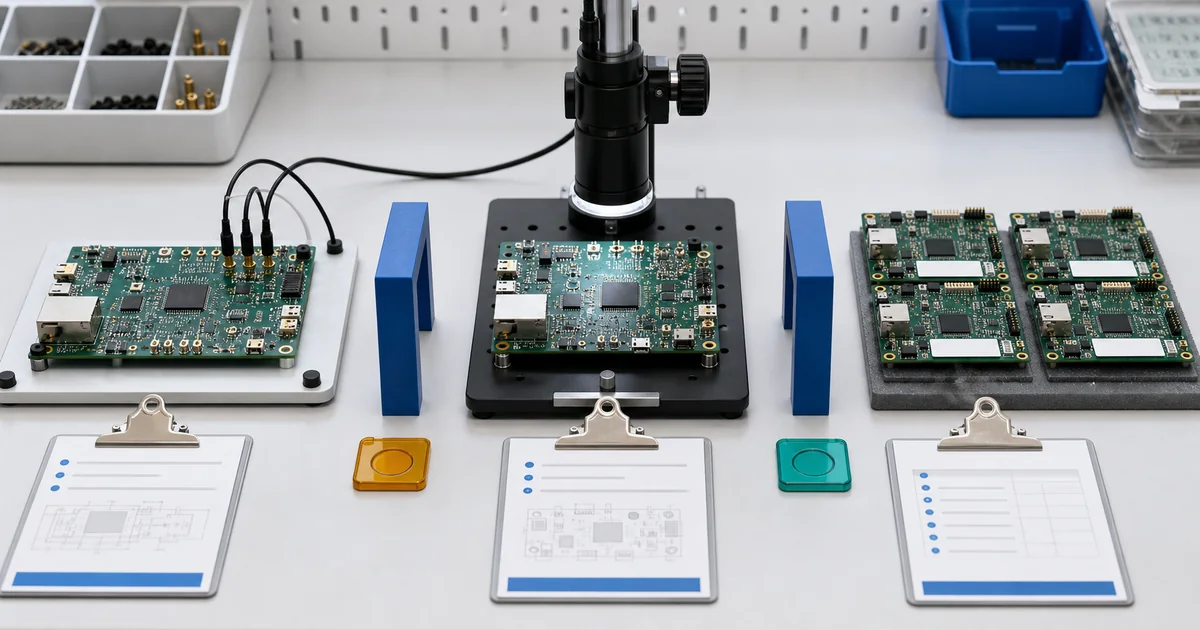
| Gate | Decision to close | Required evidence | Hold condition |
|---|---|---|---|
| 1. Revision | Which design and variant will be repeated? | Released Gerber, drill, BOM, CPL, drawings, firmware and change record | Files contain mixed or provisional revisions |
| 2. Bare board | Can the fabricated PCB support the repeat build? | Stack-up, material, finish, dimensions, electrical-test requirement and approved fabrication data | Critical board assumptions remain implicit |
| 3. Material | Can approved parts be purchased for the pilot quantity? | Exact MPNs, source rules, dated availability, alternates, MOQ and excess ownership | A critical line has no controlled purchase path |
| 4. Process | What setup and workmanship evidence is required? | Panel/fixture assumptions, paste and assembly notes, inspection plan and acceptance source | The partner must infer critical process requirements |
| 5. First article | Did the setup produce an acceptable first result? | Identity, fitted state, orientation, inspection, programming and initial measurements | Remaining units would run before disposition |
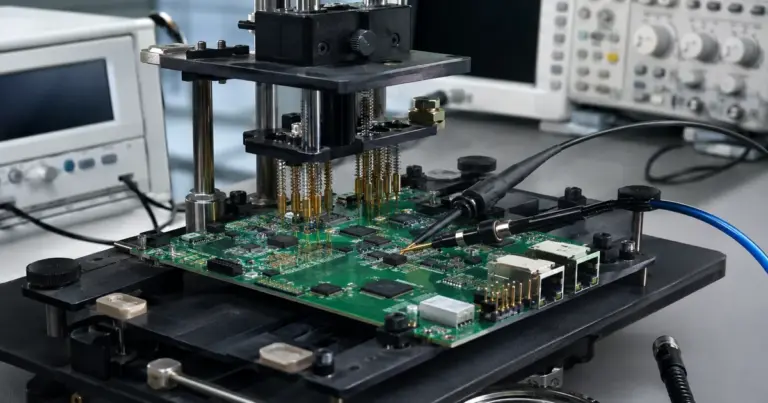
| 6. Test | Can every unit be evaluated consistently? | Controlled firmware, fixture/interface, sequence, limits, logging and failure disposition | Pass/fail depends on one engineer’s judgment |
| 7. Release | Who authorizes the remaining batch? | Signed or recorded proceed/hold/deviation decision with evidence links | No named release owner or open critical issue |
The gates are not seven separate departments. On a small project, one engineer may own several. The control comes from explicit evidence and decision authority, not organization size.
Gate 1: freeze one manufacturing baseline
Release one coherent package. Gerber, drill, BOM, component placement, drawings, firmware and test instructions should identify the same revision and variant.
Include a manifest with filenames, revision, export date and approval owner. If a file changes after quotation, record whether the quote, material order, programming plan or test method must be reopened.
Gate 2: protect bare-board assumptions
The next PCB lot can differ even when the artwork does not. Make the board requirements visible:
- layer count and stack-up;
- material or performance requirements;
- finished thickness and copper assumptions;
- surface finish;
- controlled impedance where required;
- critical dimensions, slots and tolerances;
- electrical testing and required reports;
- panelization or delivery format.
Do not infer that prototype board acceptance qualifies every future fabrication source. Confirm the actual project and partner.
Gate 3: release a purchasable BOM
The pilot BOM should distinguish approved parts from proposed alternates. Date critical stock and lead-time checks. Define buyer-supplied material, approved source rules, excess ownership and what happens when availability changes after release.
For the preventive design-stage process, see Design for Availability Before PCB Layout Freeze. For current market revalidation, see Electronic Component Lead Times in 2026.
Gate 4: define evidence before the setup runs
Inspection names alone are not a plan. State what each method must show and its limitation. Visible joints, hidden BGA/QFN connections, polarity, programming and electrical behavior require different evidence.
If IPC or another acceptance document is contractual, specify the document, revision and class in the purchase information. Do not assume a standard, certification or equipment capability applies to every partner or project.
Gate 5: stop at the first article
The first article is a manufacturing release point, not another design prototype. Before the rest of the pilot proceeds, verify:
- board and assembly revision;
- fitted and DNP state;
- part identity where controlled;
- orientation and polarity;
- agreed workmanship evidence;
- firmware identity;
- initial measurements and functional checks;
- deviations and their disposition.
Use the dedicated PCB Assembly First Article Inspection guide for the detailed checklist once that resource is public.
Gate 6: turn bench bring-up into a controlled test
An engineer may know that a board “looks right” after several manual steps. A pilot requires the steps and acceptance limits to be transferable.
Release:
- safe power and sequencing;
- connectors, pads, fixtures and access;
- firmware image, version and programming instructions;
- ordered actions and stimuli;
- expected values with units and tolerances;
- log format and unit identity;
- retest and failure disposition rules.
A golden unit can support correlation. It should not be the only definition of pass.
Gate 7: authorize the remaining quantity
Record one of three decisions:
- Proceed: required evidence is complete and no open issue blocks the batch.
- Hold: work stops until named evidence or corrective action is complete.
- Approved deviation: an authorized owner accepts a bounded difference, affected units and follow-up action.
The decision record should name the assembly revision, first-article identity, reviewer, date, linked evidence and remaining quantity.
Worked example: 10 prototypes to a 100-unit pilot
This example is hypothetical and illustrates allocation, not a universal sampling rule.
A team built 10 engineering prototypes. Eight operate normally, one has a hand-reworked power path and one is reserved for destructive analysis. The next order is 100 units.
The team should not label the 100-unit order “same as prototype” and release it without gates. It might instead allocate:
| Allocation | Purpose |
|---|---|
| First assembled unit | Setup, identity and workmanship release |
| Additional early units | Programming, current draw and functional correlation |
| Defined pilot subset | Thermal, interface or environmental validation required by the project |
| Remaining units | Continue only after the release owner closes the early evidence |
The exact counts depend on product risk, test capacity and contractual requirements. The information gain is the explicit stop point, not the example quantity.
What this process does not prove
A pilot does not prove unlimited scale, field reliability, regulatory compliance or every future supplier lot. First-article evidence does not replace functional test. A passed functional test does not prove hidden-joint workmanship. Each result supports a defined question and must be kept within that boundary.
How Cyrionix applies the model
Cyrionix coordinates quotation, engineering communication and build execution with manufacturing partners in Shenzhen. Project-specific board fabrication, package, inspection, programming and test capability must be confirmed before release. Cyrionix does not present the partner network as an owned factory.
Start with the PCBA Prototyping Guide and Prototype PCB Assembly service. Submit the revision-controlled package through the RFQ form.
Frequently asked questions
Is EVT/DVT/PVT the same for every hardware company?
No. The labels vary by organization and product. Define the question, evidence and release authority for each stage instead of relying on the label alone.
How many units should a pilot run contain?
There is no universal count. Choose the quantity needed to exercise the planned process, gather required evidence and support the next decision without creating unnecessary inventory exposure.
Can the first article be one of the pilot units?
Often yes, if it is identified, inspected, tested and dispositioned under the released plan. The remaining batch should not proceed before the defined release decision.
Does a successful pilot mean the design is ready for mass production?
Not automatically. Scale may require additional process capability, fixture capacity, supply coverage, reliability, compliance and change-control evidence.
Sources
- IPC document revision table
- KiCad PCB Editor documentation
- Reddit engineering discussion: prototype to production, July 2026
Request a project-specific PCBA review after the revision, quantity, evidence and open decisions are defined.