
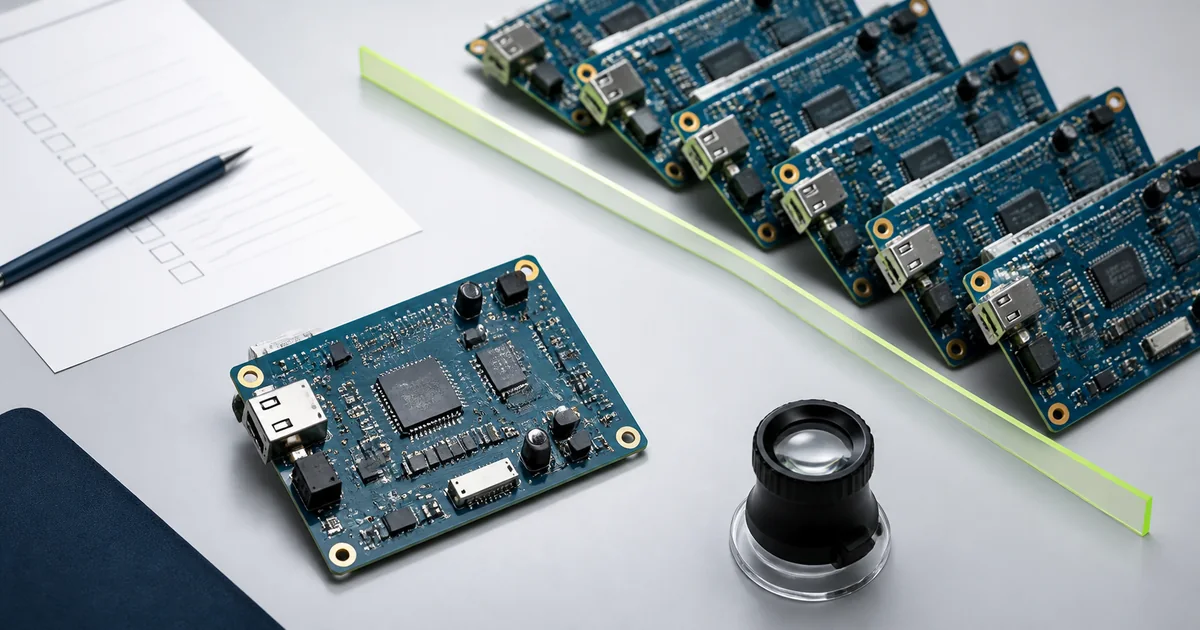
Before batch release, confirm revision, part identity, fitted state, orientation, agreed workmanship evidence, programming and defined test results. Record every deviation and release authority.
FAI is a manufacturing release decision
Design validation asks whether the product meets engineering intent. First article inspection asks whether the released data, loaded parts, setup and agreed verification produced an acceptable first result before that result is repeated.
PCB First Article Release Gate
Identity
Match board revision, BOM, placement data, drawings, firmware and traveler to the released package.
Build evidence
Check fitted/DNP state, part identity, orientation, workmanship and agreed inspection evidence.
Product evidence
Run only the defined programming, measurement and functional checks with controlled limits.
Disposition
Release, hold or correct the remaining batch; record deviations, authority and evidence.
First Article Inspection Checklist
| Review area | Evidence to review | Release question | Hold condition |
|---|---|---|---|
| Revision identity | Board marking, fabrication outputs, BOM, CPL, drawings and change record | Do all artifacts describe one released build? | Mixed or ambiguous revision |
| Part identity | MPN, value, package, lot/date information where required | Are fitted parts the approved identities? | Unapproved substitution or unresolved package |
| Fitted / DNP state | BOM state, assembly drawing and first article | Are all and only intended designators fitted? | Mismatch between data and physical assembly |
| Orientation / polarity | Drawing, datasheet marking and physical result | Do polarized and oriented parts agree with the release? | Any unresolved orientation |
| Workmanship evidence | Selected visual, AOI or X-ray records and agreed criteria | Does evidence cover the defined risks? | Required evidence missing or nonconforming |
| Programming | Controlled image, version, checksum or programming log where applicable | Was the intended image applied and identified? | Version or method cannot be verified |
| Measurements / function | Defined sequence, safe limits and results | Do recorded results meet released criteria? | Limit, method or result is ambiguous |
| Deviation control | Issue list, concession/waiver, corrective action and owner | Are all departures accepted by authorized owners? | Open issue has no disposition |
| Batch release | Signed or recorded decision, date and evidence location | Is there explicit authority to continue? | No named release authority |
Minimum report fields
- Project, assembly, revision and first-article serial or identifier
- Released document set and revision
- Inspection and test methods actually performed
- Results, attached evidence and acceptance source
- Deviations, disposition, owner and due date
- Release / hold decision, authority and timestamp
Planning the first 100 units
Do not assume the first board, first panel or a fixed percentage is always the correct sample. Allocate units around process risk, destructive checks, firmware and test needs, then identify the point at which the remaining quantity may proceed.
If IPC-A-610 or another acceptance document applies, identify the revision and class in the purchase documentation. This page does not claim Cyrionix certification or AS9102 compliance.
Sources and scope
- IPC technical paper: first article inspection setup — useful concepts for cross-checking setup and inspection data.
- IPC certifications and standards context — separates standards/certification context from project claims.
Continue the decision path
Use the related service and engineering guides to define the project scope before quotation or release.
Need a project-specific review?
Share the released files, quantity, open decisions and required evidence.