
Risk-safe lead-time compression for How to Reduce PCB Assembly Lead Time Without Creating More Risk

How to Reduce PCB Assembly Lead Time Without Creating More Risk

Direct answer: The practical answer to "Which actions shorten PCB assembly lead time without shifting risk downstream?" is to use a documented decision gate, not a generic supplier promise. The target outcome is a risk-ranked checklist that separates true compression from omitted work. Start with the package readiness gate: Release one coherent package and close known questions early. Then review the package and people who can approve exceptions. Hold the project when expedite begins with provisional data. Exact manufacturing, inspection, sourcing, and test scope depends on the selected design and partner. This guide makes scope explicit before quotation, release, or the next build decision.

What decision does this guide support?

Teams often expedite before fixing missing data or unavailable parts, making the critical path longer. This guide helps engineering teams with a real deadline make decisions about schedule reduction. Its information gain is a lead-time reduction checklist ranked by risk and decision deadline. The framework below is a project-control tool, not a claim that one process, supplier, quantity, or lead time fits every board.

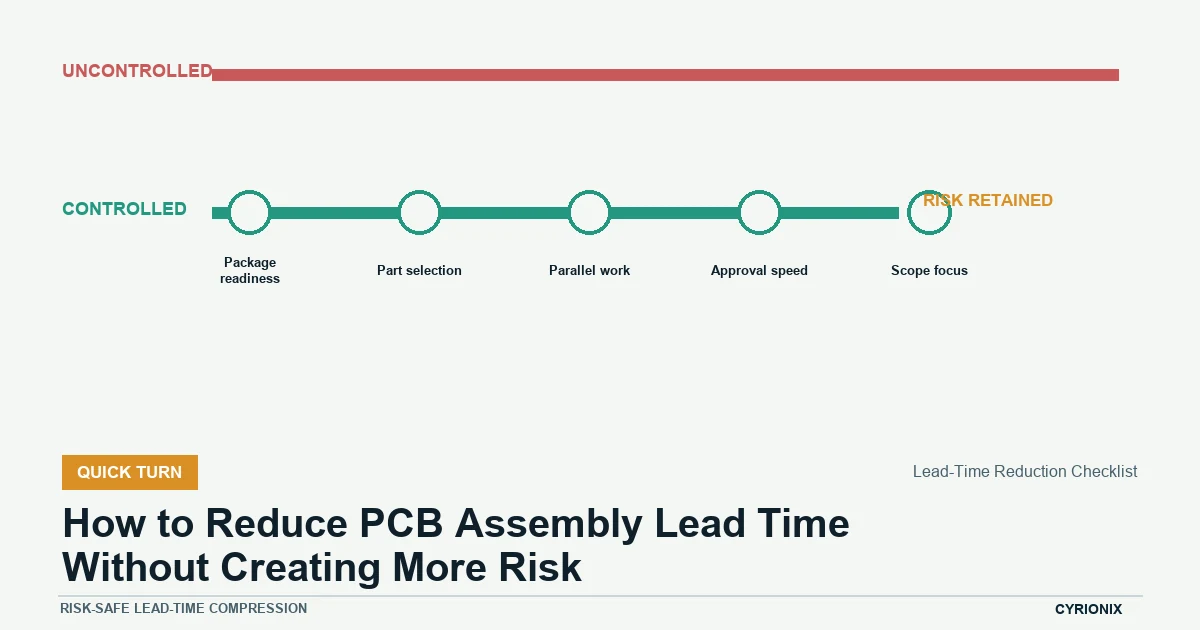
Lead-Time Reduction Checklist for quick turn PCB assembly decisions
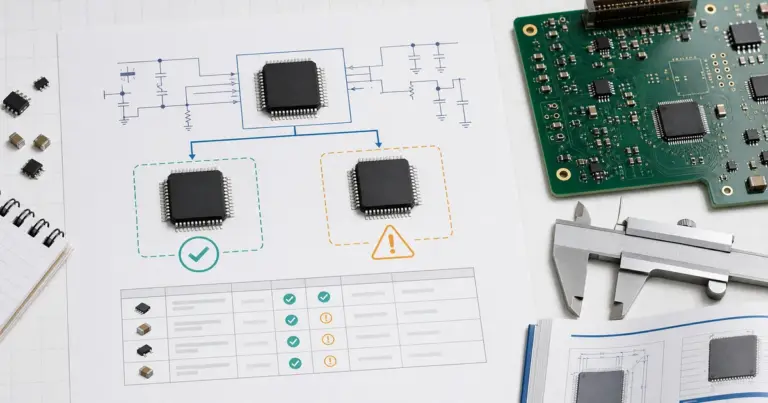
Illustrative decision framework; it is not a photograph of a Cyrionix-owned factory or production line.

Lead-Time Reduction Checklist

Use this framework at the point where a project could otherwise move forward on an assumption. Each row names the evidence needed and a condition that should stop release until an owner resolves it.

Checklist itemRequired evidenceHold condition
Package readinessRelease one coherent package and close known questions early.Expedite begins with provisional data.
Part selectionCheck availability and approved alternatives before design release.A critical part has no viable supply path.
Parallel workPrepare boards, components, programming, and testing concurrently where safe.Parallel lanes depend on an unresolved baseline.
Approval speedAssign reachable owners and bounded response windows.A substitution or deviation waits without escalation.
Scope focusPrioritize evidence needed for the current decision while preserving safety and traceability.Compression removes an essential acceptance step.
LogisticsConfirm destination, packaging, and transport before the build finishes.Completed boards wait for shipping instructions.

Map the critical path

For the map the critical path step, use Package readiness as the control point. Release one coherent package and close known questions early. Treat this as a release decision rather than an administrative detail. Place the build on hold when expedite begins with provisional data. Record the input reviewed, its revision or date, the decision owner, and the action required. That record keeps a later sourcing, assembly, test, or repeat-batch decision tied to the same baseline.

Release complete files

For the release complete files step, use Part selection as the control point. Check availability and approved alternatives before design release. The useful evidence is a record another person can review without reconstructing the conversation. Place the build on hold when a critical part has no viable supply path. Record the input reviewed, its revision or date, the decision owner, and the action required. That record keeps a later sourcing, assembly, test, or repeat-batch decision tied to the same baseline.

Design around purchasable parts

For the design around purchasable parts step, use Parallel work as the control point. Prepare boards, components, programming, and testing concurrently where safe. This check should connect engineering intent to a purchasing or manufacturing action. Place the build on hold when parallel lanes depend on an unresolved baseline. Record the input reviewed, its revision or date, the decision owner, and the action required. That record keeps a later sourcing, assembly, test, or repeat-batch decision tied to the same baseline.

Freeze approvals

For the freeze approvals step, use Approval speed as the control point. Assign reachable owners and bounded response windows. A short written rule is more valuable than a broad assurance because it exposes the next owner. Place the build on hold when a substitution or deviation waits without escalation. Record the input reviewed, its revision or date, the decision owner, and the action required. That record keeps a later sourcing, assembly, test, or repeat-batch decision tied to the same baseline.

Pre-plan programming and test

For the pre-plan programming and test step, use Scope focus as the control point. Prioritize evidence needed for the current decision while preserving safety and traceability. The aim is not maximum paperwork; it is to prevent an unapproved assumption from entering the build. Place the build on hold when compression removes an essential acceptance step. Record the input reviewed, its revision or date, the decision owner, and the action required. That record keeps a later sourcing, assembly, test, or repeat-batch decision tied to the same baseline.

Avoid false shortcuts

For the avoid false shortcuts step, use Logistics as the control point. Confirm destination, packaging, and transport before the build finishes. Close the step with an explicit pass, hold, or approved-deviation result. Place the build on hold when completed boards wait for shipping instructions. Record the input reviewed, its revision or date, the decision owner, and the action required. That record keeps a later sourcing, assembly, test, or repeat-batch decision tied to the same baseline.

How to use the framework on a real project

  1. Define the baseline. Identify the board revision, assembly variant, quantity, intended learning or delivery outcome, and files being reviewed.
  2. Assign decisions. Name who can approve engineering changes, sourcing substitutions, process deviations, test failures, and schedule tradeoffs.
  3. Record the result. Store the pass, hold, or deviation outcome with the build package so a repeat order does not depend on memory.

Questions to close before release

What evidence is sufficient?

Evidence should match the risk. A file reconciliation may be enough for one decision; a datasheet comparison, inspection record, controlled test, or engineering approval may be needed for another. The key is that the evidence is named before work proceeds.

Who owns an exception?

The party executing purchasing or manufacturing can identify an issue and present options, but changes to functional intent require an authorized customer engineering decision. Put that boundary in the RFQ or release record.

When should the project stay on hold?

Hold when the next action would make an unresolved assumption expensive, irreversible, unsafe, or difficult to trace. A documented hold is usually less costly than discovering after assembly that teams used different revisions or acceptance criteria.

Related Cyrionix resources

This guide strengthens the quick turn pcb assembly topic owner. Supporting resources:

Technical references

Next step: For a deadline review, use the quick-turn service page without assuming a universal turnaround.

Similar Posts