Manufacturing Handoff Checklist for a Controlled PCB Assembly Build
Direct answer: A PCB assembly manufacturing handoff is ready only when the assembler can identify the released hardware, buy the intended parts, interpret assembly notes, load the correct firmware, apply defined acceptance criteria, and route exceptions to a named approver. Sending Gerbers and a BOM is not enough. The release package should be internally consistent, revision-controlled, and accepted by both engineering and the manufacturing coordinator before purchasing or production starts.
What decision does this guide support?
Use this checklist when a design is leaving the engineering workspace and becoming a controlled physical build. It is intended for hardware leads, operations managers, and buyers who need to decide whether the package is complete enough to release. The central question is not whether every document exists, but whether another team can execute the build without reconstructing design intent from email or memory.
Manufacturing handoff checklist
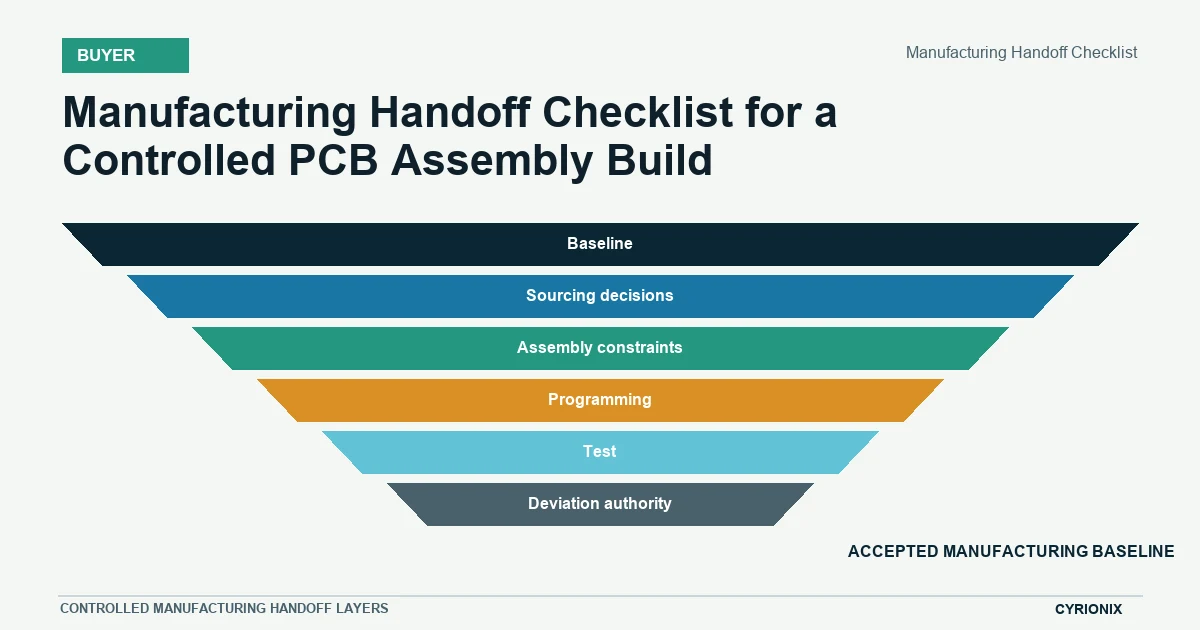
Review the six controls as one release gate. A row marked “hold” means the missing decision can change cost, schedule, board identity, or acceptance after work has begun.
| Checklist item | Required evidence | Hold condition |
|---|---|---|
| Baseline | Release one revision, variant, firmware, and acceptance set. | Manufacturing receives provisional or conflicting files. |
| Sourcing decisions | Transfer approved sources, alternates, constraints, shortages, and material ownership. | A purchasing question requires undocumented design intent. |
| Assembly constraints | Transfer polarity, handling, critical joints, depanelization, and workmanship notes. | Critical knowledge exists only with one engineer. |
| Programming | Transfer binaries, versioning, access, settings, serialization, and verification. | The correct image cannot be proven per unit. |
| Test | Transfer fixtures, scripts, limits, expected results, data format, and failure disposition. | Pass/fail depends on tribal knowledge. |
| Deviation authority | Name who can approve substitution, rework, use-as-is, or schedule tradeoffs. | Manufacturing must guess who owns a decision. |
Freeze one manufacturing baseline
Create a release manifest that names the PCB revision, assembly variant, BOM revision, placement-file revision, drawing set, firmware version, and quantity. Remove obsolete files from the transfer folder instead of relying on labels such as “latest.” A useful manifest lets the recipient reconcile every file to the same assembly without opening the CAD project.
Make sourcing intent purchasable
For each BOM line, provide an orderable manufacturer part number, approved source constraints, and the rule for alternates. Identify consigned material, existing inventory, minimum date-code or traceability requirements, and any part that must not be substituted. Open sourcing questions belong in a visible exception log; they should not be hidden inside a quoted total.
Translate design knowledge into assembly instructions
Polarity, orientation, do-not-populate rules, hand-solder operations, thermal restrictions, panel handling, and critical mechanical interfaces need explicit evidence. A drawing, annotated image, or controlled note is preferable to a verbal instruction. Where workmanship acceptance matters, state the agreed standard or project-specific criterion and the applicable class rather than writing only “IPC compliant.”
Release programming and test as controlled inputs
Link each binary to the hardware revision and record the programming interface, tool settings, security or serialization rules, and verification method. Test documentation should identify the fixture, software version, limits, expected outputs, data to retain, and disposition for failures. These inputs should mature in parallel with fabrication, not after assembled boards are waiting.
Name the people who can approve deviations
The build team may discover a shortage, footprint discrepancy, solderability concern, or test failure. Define who can approve a substitute, rework, use-as-is disposition, or schedule tradeoff, and how that approval will be recorded. Manufacturing can present evidence and options; it should not infer a change to functional intent.
Accept the handoff before releasing spend
Hold a short cross-functional review and close every item as accepted, open with an owner and due date, or formally waived. Record the result beside the release manifest. This creates a traceable starting point for the first article and prevents a repeat order from inheriting an undocumented exception.
A practical handoff sequence
- Engineering packages the baseline. Export the manufacturing files, generate the manifest, and perform a final comparison against the released design.
- Operations reconciles execution inputs. Check sourcing ownership, quantity, schedule, programming, test, packaging, and delivery requirements.
- Both parties close exceptions. Record approvals before purchase or fabrication and issue a revised manifest if a controlled input changes.
Manufacturing handoff questions
Who should approve the final handoff?
The design owner should approve technical intent, while the person accountable for procurement or manufacturing should confirm that the package is executable. One person can hold both roles in a small team, but the two decisions should still be recorded separately.
Is an assembly drawing always required?
Not every simple board needs a complex drawing, but the package needs an unambiguous source for polarity, population variants, mechanical restrictions, and special operations. If the centroid file and silkscreen do not communicate those items reliably, an assembly drawing or annotated visual is warranted.
What should trigger a new release?
Any change that affects board identity, purchased material, placement, firmware, test limits, or acceptance should create a controlled revision or documented deviation. Correcting a spelling error does not necessarily require the same process; changing an approved part does.
Related Cyrionix resources
For file-level preparation, review the PCB assembly file checklist. Teams deciding whether the next build is still exploratory or ready for a controlled repeat run can use the prototype versus low-volume framework.