Low-Volume PCB Assembly vs Mass Production: What Changes?
Direct answer: Low-volume PCB assembly is organized around learning, controlled changes, and limited material commitment; mass production is organized around repeatability, throughput, and forecast-backed supply. The right transition point depends on process stability and demand evidence, not a universal unit threshold.
What decision does this guide support?
This comparison helps teams decide whether a build should remain flexible or begin adopting production-scale controls and commitments. It separates setup, purchasing, change, test, inventory, and scaling decisions.
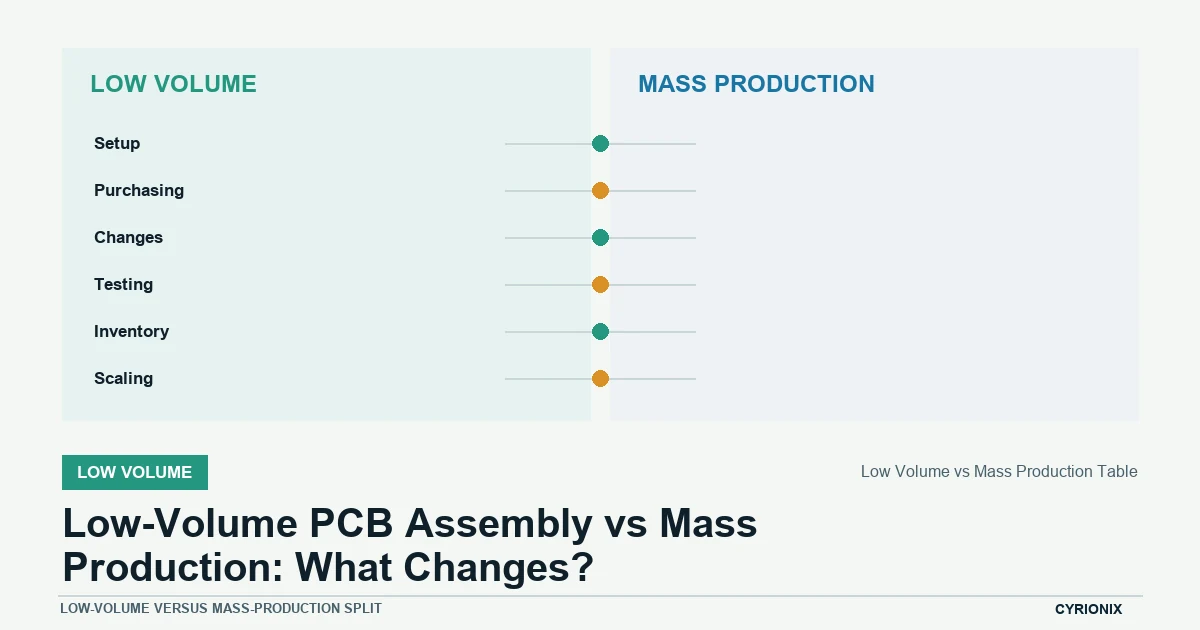
Low Volume vs Mass Production Table
Evaluate the operating model behind the quantity. Two orders with the same unit count may need different controls when one is still validating the design and the other is replenishing a stable product.
| Control point | Required action or evidence | Hold condition |
|---|---|---|
| Setup | Low volume absorbs setup over fewer units; mass production invests in repeatability. | Unit price is compared without separating fixed work. |
| Purchasing | Small batches prioritize availability and exposure; scale prioritizes continuity and terms. | MOQ, excess material, and lifecycle risk are hidden. |
| Changes | Low volume can accept controlled learning; mass changes require broader disposition. | Revision flexibility is mistaken for informal control. |
| Testing | Low volume may use targeted/manual methods; scale needs repeatable coverage and data. | The test method cannot support the expected throughput. |
| Inventory | Small runs minimize commitment; scale needs forecasts, buffers, and liability rules. | Inventory ownership is undefined. |
| Scaling | A pilot should expose process limits before volume commitments increase. | The team is scaling before closing known build issues. |
The decision is not a quantity label
Volume alone does not reveal design maturity, demand confidence, test readiness, or supply continuity. Define what the batch must prove and which uncertainties should be closed before increasing commitment.
Setup and process control
Low-volume work spreads stencil, programming, setup, and first-article effort across fewer units. Mass production justifies greater investment in repeatable fixtures, process windows, automation, and line-rate evidence.
Purchasing and inventory
Small batches usually prioritize availability and limited exposure, while scale requires forecasts, negotiated terms, buffers, and liability rules. Compare fixed work, MOQ, excess material, and lifecycle risk separately from unit assembly price.
Engineering-change flexibility
A low-volume run can absorb controlled learning because fewer units are committed. At scale, a change can affect open orders, tooling, work in progress, finished stock, packaging, firmware, test, and field traceability.
Testing and traceability
Targeted or manual methods may provide enough evidence for a prototype or pilot. Higher throughput requires repeatable coverage, controlled software and fixtures, measurable limits, serialization, and a defined failure path.
Scale-readiness questions
Scale only after known build issues are closed, the package is stable, critical supply paths are understood, and test can support expected throughput. A larger purchase order should not be used to discover whether the process is repeatable.
Decide what the next batch must prove
- Name the remaining uncertainty. Separate design, process, supply, test, and demand questions.
- Match the commitment. Choose quantity and controls that limit exposure while producing useful evidence.
- Set scale gates. Define the results required before tooling, inventory, or throughput commitments increase.
Related Cyrionix resources
Compare the low-volume PCB assembly service with the prototype-versus-low-volume guide before choosing the next build stage.