
PCB Fabrication and Assembly for Prototype and Low Volume
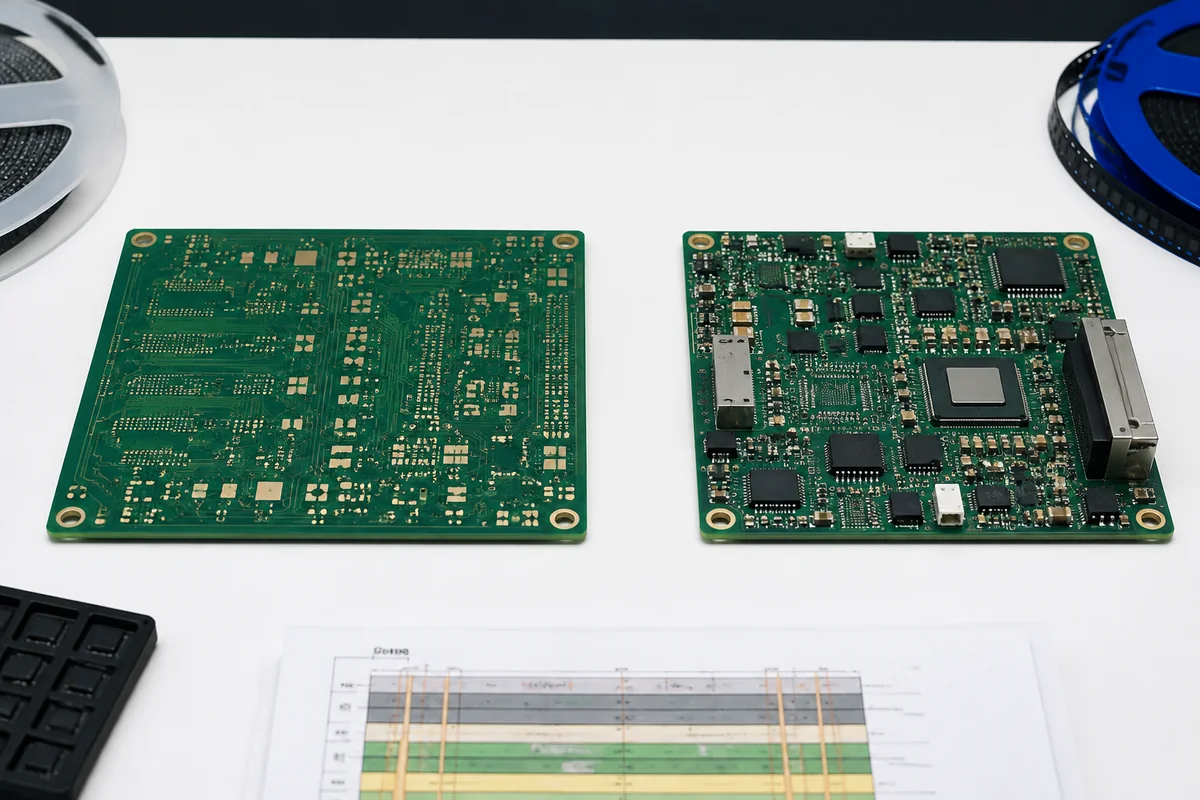
PCB fabrication creates the bare board. PCB assembly purchases or receives components, places them, solders them and applies the agreed inspection or test scope. Coordinating both stages from one release reduces handoff ambiguity, but it does not remove the need for explicit technical approvals.
What does a combined PCB fabrication and assembly service include?
A combined PCB fabrication and assembly service coordinates the bare-board specification, panel and fabrication questions with component sourcing or kitting, SMT/THT assembly, and the agreed verification and delivery steps. The customer still defines design intent, approved material, acceptance criteria and deviation authority. Cyrionix confirms the board and assembly route with manufacturing partners selected for the actual files, quantity and schedule.
Keep fabrication and assembly specifications separate but connected
A single commercial contact is useful only when each technical boundary remains visible. The bare board and populated assembly have different inputs, failure modes and acceptance evidence.
| Stage | Primary inputs | Key decisions | Evidence before release |
|---|---|---|---|
| PCB fabrication | Gerber/ODB++, drill, outline, stack-up, material and finish | Layer construction, impedance, copper, hole structures, panel and tolerances | Fabrication questions closed and board revision identified |
| Component supply | BOM, AVL, approved alternates, quantity and ownership | Source, packaging, MOQ, attrition, excess and shortages | Exact MPNs and approval status reconciled |
| PCB assembly | CPL/centroid, drawings, polarity, DNP and process notes | SMT/THT sequence, manual operations, handling and depanelization | Placement data checked against board and BOM |
| Verification | Workmanship criteria, firmware, test method, limits and fixtures | Coverage, sample size, recorded results, failure and retest rules | Quoted deliverables match the intended acceptance decision |
| Delivery | Label, packaging, quantity, destination and shipping basis | Serialization, moisture/ESD protection and logistics responsibility | Finished-goods identity and delivery scope defined |
Resolve the questions at the stage where they originate
Fabrication assumptions can propagate into stencil, placement, soldering and test. A controlled handoff catches them before value is added to the wrong baseline.
Confirm outline, drill data, layer order, material, copper, finish, impedance notes and panel requirements. Record any supplier-proposed construction change before fabrication.
Use orderable manufacturer part numbers and explicit variant rules. Resolve parts that are unavailable, obsolete, not assembly-packaged or subject to customer sourcing restrictions.
Compare reference designators, side, origin, rotation and polarity across the CPL, assembly drawing, BOM and rendered board. A syntactically valid export can still describe the wrong revision.
Identify surface-mount, through-hole and manual operations, critical packages, thermal restrictions, cleaning or coating notes and any customer-supplied fixtures.
State what is inspected or tested, the relevant criteria, data to retain and who decides the disposition of a nonconforming or failed unit.
Fewer vendor handoffs, with the same engineering discipline
Combined PCB manufacturing and assembly can shorten communication paths and place panel, stencil and assembly questions in one workflow. It is not automatically faster if files, material or test inputs remain open.
Panel decisions affect more than bare-board price
Panel dimensions, rail features, fiducials, tooling holes, breakaway method and component clearance can influence both fabrication yield and assembly handling. The selected partner should review panel context against the assembly route instead of optimizing only board utilization.
Parts determine the practical assembly start
The latest required usable component often controls setup. A quote should distinguish available stock from ordered or proposed material and show MOQ or excess exposure where it matters. Use component sourcing with documented decisions when the BOM includes constrained or customer-controlled parts.
First-article evidence prevents a full-batch interpretation error
For a new or changed design, identify what must be reviewed before the remaining quantity proceeds: assembly identity, orientation, workmanship, programming, measured rails or product function. The exact first-article approach depends on batch size and process, but its approval owner should not be implicit. See the first-article inspection checklist.
Combined supply does not mean unlimited scope
Board types, surface finishes, component packages, solder processes and test methods vary by manufacturing partner. Cyrionix confirms required capabilities from the actual design instead of publishing a universal equipment claim.
Send the inputs that control cost and lead time
A PCB fabrication and assembly quote is only comparable when suppliers use the same board revision, BOM, quantity, verification scope and delivery basis.
Board specification
Complete manufacturing data, stack-up intent, impedance, material, copper, finish, tolerances and panel constraints.
Population package
BOM, CPL, assembly drawing, variant/DNP rules, polarity evidence and special process notes.
Defined result
Workmanship criteria, programming inputs, inspection coverage, test limits, fixture ownership and report needs.
Common comparison basis
Quantity breaks, target date, material model, excess-material ownership, packaging and destination.
Useful starting point: Download or follow the PCB assembly file guide before issuing the RFQ.
Questions about combining fabrication and assembly
Resolve ownership of the board data, component data and acceptance evidence before the combined order is released.
What is the difference between PCB fabrication and PCB assembly?
Fabrication produces the bare printed circuit board from manufacturing data. Assembly places and solders components onto that board and may include programming, inspection and testing defined for the project.
Is it better to use one supplier for fabrication and assembly?
It can reduce handoffs and make panel, board and assembly questions easier to coordinate. Separate suppliers may still be appropriate for qualified board sources, proprietary processes or commercial reasons. Compare control, evidence and total lead time rather than assuming one model is always better.
What files are needed for a PCB fabrication and assembly quote?
Provide fabrication data, drill files, stack-up or impedance notes where applicable, a BOM with exact manufacturer part numbers, placement data, assembly drawings, quantity, variant, test requirements and destination.
Can I supply my own PCB or components?
A consigned or partial-turnkey build may use customer-supplied boards or components. Packaging, quantity, traceability, incoming checks, attrition allowance and unused-material disposition must be agreed.
Does combined service include functional testing?
Only when the quotation defines the test procedure, inputs, fixture and software responsibility, limits, coverage, retained results and failure disposition.
Complete the combined build package
Use these service and engineering pages to close the remaining board, BOM and volume decisions.
Release one board-to-assembly baseline
Send the fabrication package, BOM, placement data, quantity and acceptance requirements for a coordinated scope review.