
Research Data Note
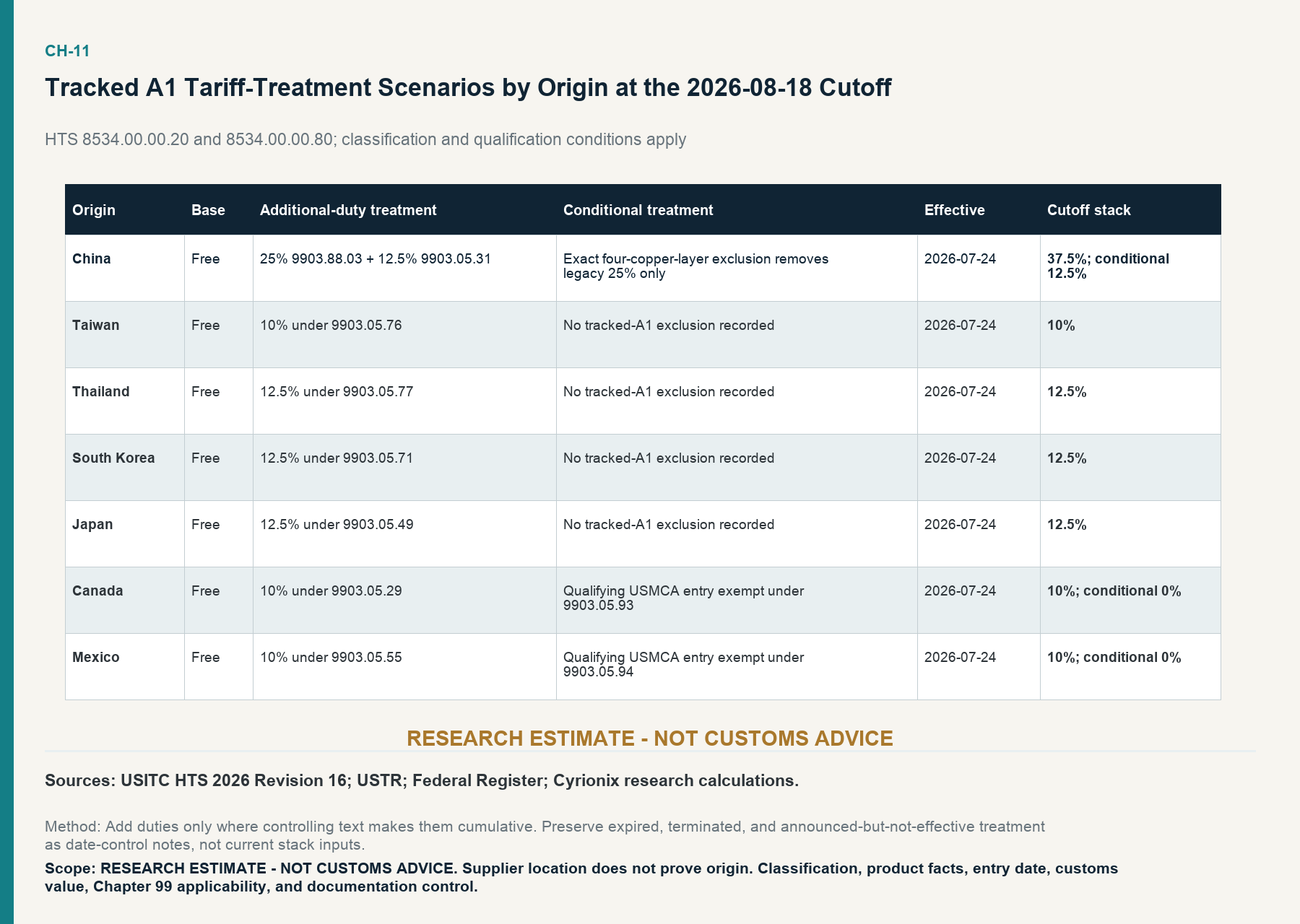
Tariff read: For PCB tariffs by origin in 2026, the two tracked HTS 8534 printed-circuit classifications carried a Free Column 1 General base rate at the evidence cutoff, but Chapter 99 treatment differed by origin, entry date, and qualification. The table is a dated research matrix, not a universal rate sheet.
Data notes
Publisher
Cyrionix
Geography
U.S. imports / selected origin scenarios
Primary sources
USITC HTS 2026 Revision 16; USTR; Federal Register
Classification
HTS 8534.00.00.20 and 8534.00.00.80
Metric
Conditional ad valorem research stack at the cutoff
Calculation
Free base plus applicable cumulative Chapter 99 duties; conditional treatment kept separate
Effective-date control
2026 action effective July 24, 2026
Parent research
North American PCB & PCBA Sourcing in 2026
Tracked A1 tariff-treatment scenarios
| Origin scenario | Column 1 General base | Additional-duty treatment | Conditional exclusion or exemption | Cutoff research stack |
|---|---|---|---|---|
| China | Free | 25% legacy Section 301 under 9903.88.03 + 12.5% 2026 action under 9903.05.31 | Exact four-copper-layer 8534.00.00.20 product-description exclusion through November 9, 2026 removes only the legacy 25% when every specification is met | 37.5%; conditional 12.5% for exact qualifying subsetRESEARCH ESTIMATE — NOT CUSTOMS ADVICE |
| Taiwan | Free | 10% under 9903.05.76 | No tracked-A1 exclusion recorded in the cutoff matrix | 10%RESEARCH ESTIMATE — NOT CUSTOMS ADVICE |
| Thailand | Free | 12.5% under 9903.05.77 | No tracked-A1 exclusion recorded in the cutoff matrix | 12.5%RESEARCH ESTIMATE — NOT CUSTOMS ADVICE |
| South Korea | Free | 12.5% under 9903.05.71 | No tracked-A1 exclusion recorded in the cutoff matrix | 12.5%RESEARCH ESTIMATE — NOT CUSTOMS ADVICE |
| Japan | Free | 12.5% under 9903.05.49 | No tracked-A1 exclusion recorded in the cutoff matrix | 12.5%RESEARCH ESTIMATE — NOT CUSTOMS ADVICE |
| Canada | Free | 10% under 9903.05.29 | Qualifying USMCA duty-free entry exempt under 9903.05.93 | 10%; conditional 0%RESEARCH ESTIMATE — NOT CUSTOMS ADVICE |
| Mexico | Free | 10% under 9903.05.55 | Qualifying USMCA duty-free entry exempt under 9903.05.94 | 10%; conditional 0%RESEARCH ESTIMATE — NOT CUSTOMS ADVICE |
RESEARCH ESTIMATE — NOT CUSTOMS ADVICE. Scope: U.S. imports under HTS 8534.00.00.20 and 8534.00.00.80, HTS 2026 Revision 16, at the August 18, 2026 evidence cutoff. The 2026 action applied to covered entries beginning July 24, 2026.
How to read the scenarios
Start with the imported article, not the country label. The two tracked statistical suffixes sit under heading 8534 and carried a Free Column 1 General base rate in HTS 2026 Revision 16. Additional duties are then tested by origin, product coverage, Chapter 99 provision, entry date, and the controlling legal text. Duties are combined only where that text makes them cumulative.
China illustrates why a single headline rate is unsafe. Under the stated assumptions, the standard tracked scenario combines the 25% legacy action and the 12.5% 2026 action for 37.5%—RESEARCH ESTIMATE — NOT CUSTOMS ADVICE. A narrow exact four-copper-layer product-description exclusion can remove only the legacy 25% through November 9, 2026 when every specification is met, leaving a conditional 12.5% scenario—RESEARCH ESTIMATE — NOT CUSTOMS ADVICE. A China PCB tariff exclusion in 2026 therefore depends on product facts and the legal text, not on a code match alone.
Canada and Mexico illustrate a different qualification path. A qualifying USMCA duty-free entry is conditionally exempt from the 2026 additional duty, while a non-qualifying tracked entry produces a 10% research stack—RESEARCH ESTIMATE — NOT CUSTOMS ADVICE. USMCA PCB tariff treatment requires origin and qualification records; supplier location is not a substitute.
Date and policy controls
The applicable preserved schedule was HTS 2026 Revision 16, which the official archive labels August 14, 2026. The forced-labor Section 301 action was published July 28 and effective for covered entries beginning July 24, 2026. Those dates are part of the scenario, not background decoration.
Three controls prevent stale or announced treatment from entering the cutoff stack. The temporary 10% import surcharge ended at 12:01 a.m. EDT on July 24 and therefore contributes zero at the cutoff. Executive Order 14389 ended specified IEEPA additional ad valorem duties in February while leaving Section 301 duties unaffected. A May Taiwan notice said the referenced agreement had not entered into force; its specified implementation changes did not cover the tracked PCB classifications. These treatments are retained as date checks, not added as current duties.
What this research does not determine
The table does not classify a reader’s product, determine country of origin, establish customs value, confirm exclusion or USMCA qualification, or predict treatment after the cutoff. It does not cover populated assemblies that classify by a different function or all possible trade remedies, fees, taxes, or admissibility rules.
Tariff is only one landed-cost input. Freight, insurance, brokerage, domestic logistics, commercial terms, inventory, quality, and schedule exposure remain transaction-specific. No country row should be used as a delivered-cost comparison.
Methodology and limitations
Cyrionix preserved the controlling HTS revision and identified the base rate for the two tracked codes. The research then mapped origin-specific Chapter 99 treatment, effective dates, cumulative-treatment instructions, exclusions, and exemptions from admitted official sources. Conditional results remain conditional; expired, terminated, and announced-but-not-effective treatments are not carried into the August 18 stack.
This is a research snapshot, not a ruling. Transaction facts can change both the applicable code and the available treatment. Before entry, revalidate the schedule, legal instruments, origin analysis, product description, entry date, records, and any claimed exclusion or exemption with the importer and customs adviser.
Primary sources
- U.S. International Trade Commission, HTS archive and 2026 Revision 16 CSV.
- Office of the U.S. Trade Representative, China Section 301 List 3 and exclusion extension through November 9, 2026.
- Federal Register, 2026 Section 301 action, and the temporary surcharge record.
- The White House, Executive Order 14389; Federal Register, May 2026 Taiwan notice.