
Prototype PCB Assembly vs Low-Volume PCB Assembly: What Changes?
Compare objectives, setup cost, first-article approval, revision control, sourcing continuity and testing before releasing a repeat batch.
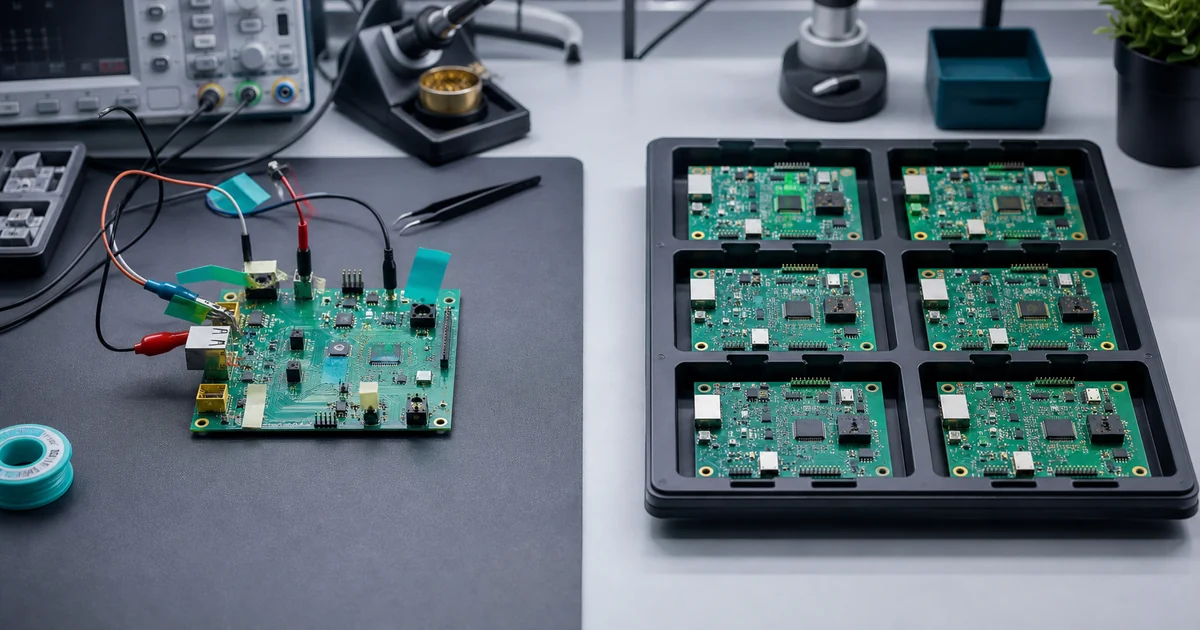
Prototype PCB assembly is optimized for learning; low-volume PCB assembly is optimized for repeating an approved configuration. There is no universal quantity at which one becomes the other. The transition happens when the design questions that could change the board are closed, one manufacturing revision is released, material decisions are controlled and the same inspection or test plan can be applied to the remaining batch.
What is the difference between prototype and low-volume PCB assembly?
A prototype build should expose design, data and manufacturing problems while changes are still expected. A low-volume build should reproduce a known configuration for a pilot, field trial, initial customer delivery or recurring specialist demand. A ten-board order can still be low-volume production if it follows a controlled release, while a larger order can remain an engineering prototype if firmware, components or acceptance criteria are still changing.
| Decision area | Prototype PCB assembly | Low-volume PCB assembly |
|---|---|---|
| Primary objective | Validate function and expose issues | Repeat an accepted configuration |
| Design status | Changes are expected between iterations | A released baseline controls the batch |
| BOM strategy | Immediate availability may support learning | Approved sources, alternates and continuity need control |
| Manufacturing feedback | Feeds the next design revision | Maintains repeatability and improves the next batch |
| Programming and test | May be engineering-led or exploratory | Uses a documented procedure and pass criteria |
| Records | Build notes and an issue list | Revision, approvals, exceptions and results retained |
| Release decision | Engineering decides what to change | An owner approves deviations before the batch continues |
Why low-volume PCB assembly costs more per board
Low-volume PCB assembly spreads fixed engineering and setup work across fewer units. The useful comparison is not component price alone. It is the total cost of releasing a controlled batch, including data review, stencil and machine setup, feeder preparation, first-article verification, programming or test preparation and any project-specific inspection.
Planning formula: estimated cost per assembly = fixed setup and engineering cost divided by released quantity + bare PCB cost + component cost + assembly cost + inspection and test cost + logistics allocation.
This formula is a planning model, not a quotation. Package mix, through-hole content, panel design, consigned material, component packaging and test responsibility change the actual cost. Increasing quantity can reduce the fixed-cost share, but ordering more boards before the revision is stable can create a larger write-off. The better question is which quantity produces enough evidence for the next decision.
| Cost driver | Why it matters in a small batch | Buyer action before RFQ |
|---|---|---|
| Setup and engineering | Review and line preparation are distributed across fewer units | Send one complete, matching release package |
| Component packaging and MOQ | Reels, trays and minimum buys can exceed the board quantity | Mark owned stock and acceptable excess-material terms |
| Manual operations | Selective soldering, rework or hand assembly adds variable labor | Identify through-hole and special-process requirements |
| Inspection and testing | Fixture or program preparation may be mostly fixed cost | Define defect targets, coverage and pass limits |
| Expedite requests | Schedule compression can require material and capacity tradeoffs | State the required arrival date and its business reason |
Seven release gates from prototype to low-volume production
- Close the critical design questions. Record unresolved electrical, thermal, mechanical, firmware and regulatory issues rather than treating them as production assumptions.
- Freeze one manufacturing baseline. Gerber or ODB++, drill data, BOM, CPL, drawings, firmware and test instructions must identify the same revision.
- Review manufacturability and assembly data. Resolve footprint, polarity, board-side, DNP, panel and special-process questions before material is committed.
- Approve the sourcing plan. Confirm exact MPNs, purchasing ownership, allowed channels, alternates, lifecycle concerns, excess material and shortage decisions.
- Define the first article. Agree which unit or sub-batch is inspected, programmed and tested, who reviews the evidence and what stops further production.
- Authorize the remaining batch. Release the balance only after deviations are dispositioned and the approved first article represents the frozen baseline.
- Retain the batch record. Keep the released files, material exceptions, approvals, inspection or test results and changes needed for the next order.
First-article approval before the remaining batch
A first article reduces the chance that one systematic error reaches every board. It does not prove the design is suitable for its end product, and it is not a substitute for customer-defined functional validation. Its purpose is to confirm that the approved manufacturing data, material decisions and assembly result agree before the balance is released.
| Check | Evidence to review | Typical stop condition |
|---|---|---|
| Identity and revision | Board marking, file revision and programmed firmware | The article does not match the released baseline |
| Material | Installed MPNs and approved substitutions | An unapproved part or source change is present |
| Assembly | Orientation, polarity, soldering and workmanship observations | A systematic placement or process issue is found |
| Programming | Firmware version, programming result and verification method | The image or interface cannot be verified |
| Functional test | Procedure, measurements and pass limits supplied by the customer | Required behavior falls outside the agreed limits |
Production planning dependencies
The assembly date is only one part of the schedule. The controlling path may be a constrained component, bare-board fabrication question, customer approval, fixture readiness, firmware release or shipping requirement. Review these dependencies together instead of assuming that a fast placement line creates a fast delivered assembly.
- Quantity now, expected reorder quantity and whether excess material may be reused
- Long-lead, allocated, obsolete or customer-controlled components
- Bare-board specifications, panel requirements and fabrication approvals
- Machine placement versus manual or selective operations
- First-article evidence and the customer response time for release
- Programming files, fixtures, interfaces, test sequence and pass criteria
- Manufacturing-complete target, shipping method, destination and required arrival date
Low-volume readiness checklist
- Has the prototype answered the critical functional questions that could change the board?
- Are Gerber, BOM, CPL, drawings, firmware and test instructions under one release?
- Are DNP status, approved alternates and substitution authority explicit?
- Are constrained parts, MOQ, excess material and follow-on sourcing risks understood?
- Can programming, inspection and functional testing be repeated with objective pass criteria?
- Is there an owner who can approve deviations without an informal email chain?
- Will the released files and batch evidence be retained for the next build?
Choose the next build stage
Build another prototype
Choose another prototype when critical design behavior, interfaces, thermals, firmware or manufacturing data still require iteration. A smaller learning build usually costs less than scrapping a controlled batch built from an unstable baseline.
Run a controlled pilot
Choose a pilot when the core design is stable but the team still needs process, test, packaging or field evidence before recurring production. Define in advance what the pilot must prove and who makes the release decision.
Release low-volume production
Choose low-volume production when the approved revision, material plan and acceptance process can be repeated without informal engineering decisions at every unit. Reopen the release if a component, file, firmware image or pass criterion changes.
Common buyer questions
How many boards count as low-volume PCB assembly?
There is no universal threshold. Board complexity, setup work, test scope and design maturity matter more than a single quantity. Treat the build as low-volume production when it follows a controlled baseline and repeatable acceptance process.
Can prototype PCB assembly move directly into low-volume production?
Yes, when critical prototype findings are closed and the exact manufacturing, sourcing, programming and test baseline is released. If those inputs are still changing, use another prototype or a controlled pilot.
Should all boards be assembled before first-article approval?
Not when a first-article hold is part of the agreed plan. The hold only protects the batch if the remaining production has not already passed the point where the identified issue can be corrected economically.
What files are needed for a low-volume PCB assembly quote?
Provide fabrication data, BOM, CPL or centroid data, assembly drawings, quantity, delivery destination and any programming, inspection or functional-test requirements. Identify the released revision and purchasing ownership.
Does low-volume production require a dedicated test fixture?
Not always. The test method should match the defects and functions that must be controlled. A fixture may improve repeatability, but the customer still needs to define interfaces, expected results and acceptance limits.
Avoid a false transition
Calling a larger prototype order “production” does not create production control. The useful transition is documented: released data, approved parts, first-article authority, defined verification, clear exception ownership and retained build feedback. Cyrionix coordinates the agreed scope through Shenzhen manufacturing partners; equipment, certification, process capability and schedule are confirmed for the actual project rather than assumed from this guide.
Specify the required standard revision and class in the project documentation. Referencing a standard does not establish that Cyrionix or every manufacturing partner holds a particular certification.
Continue your project planning
Use the related service and resource pages to turn this guidance into a reviewable manufacturing request.